The Evolution of AI Agents: From Chat Tools to Business-Ready Finance Agents
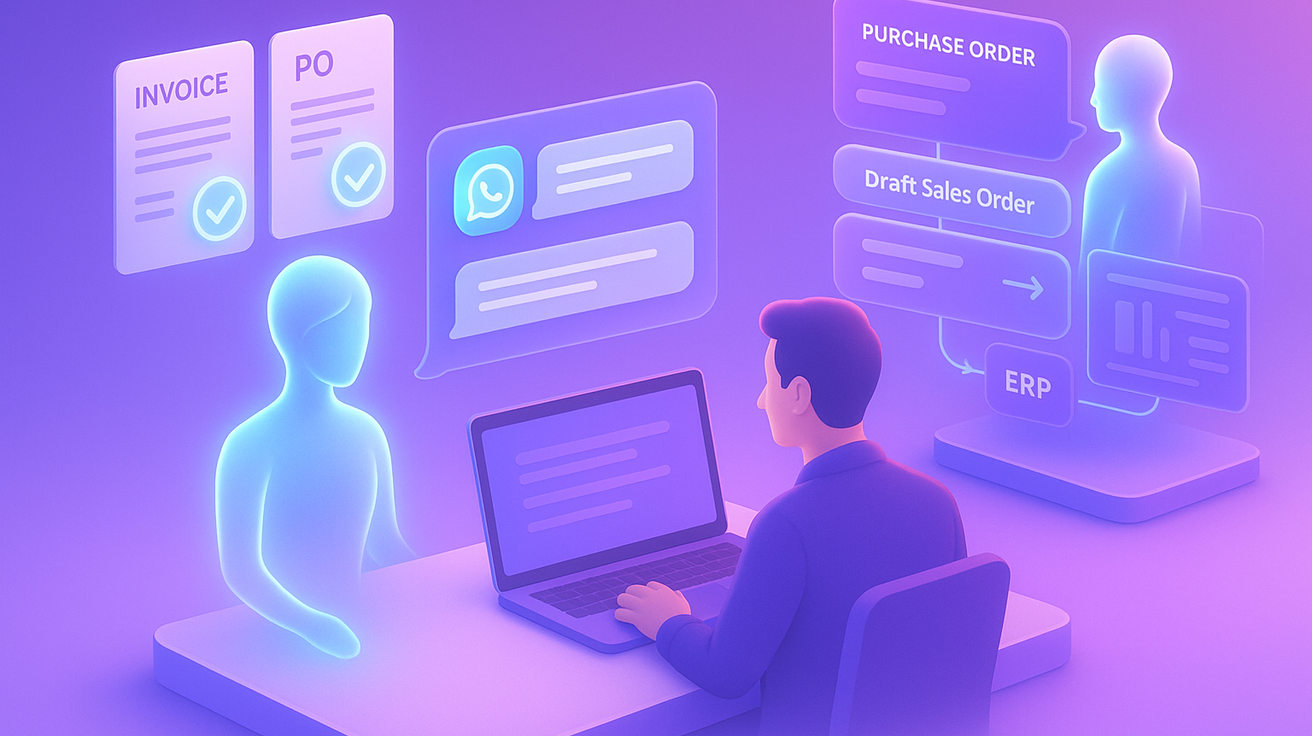
Most people met AI agents through a chat window. You type a question, the model answers, and the conversation ends there. That is a useful thing, but it is not the thing that changes how a finance team spends its week.
The more interesting shift is happening in the back office. Agents are being given a defined role, access to the systems where the work actually lives, and permission to act inside a process rather than talk about it. In accounts payable and accounts receivable, where the work is high volume, rule-heavy and document-driven, that difference is the whole point.
What an AI Agent Actually Is#
An AI agent is software that can take an instruction, decide what steps are needed, and carry those steps out. It is usually built on a large language model, which is what lets it read unstructured input such as an email, a PDF invoice or a purchase order and turn it into something a system can use.
Most agents people have encountered fall into a few familiar shapes:
- Conversational assistants that answer questions in a chat window
- Chat agents embedded in a website or an app
- General-purpose model tools used for research, summarising or data entry
These are all general-purpose. They are good at language and weak on context, because they do not know your approval matrix, your payment terms or your ERP. The next step is agents built for a specific function, with that context supplied deliberately.
Where Agents Earn Their Keep in Finance Operations#
Finance is a natural first home for this kind of automation. The inputs arrive as documents, the rules are already written down, and the exceptions are the expensive part. An agent that handles the routine path and escalates the rest fits the shape of the work.
Accounts Payable#
An accounts payable agent works the invoice queue rather than answering questions about it:
- Matching invoices against purchase orders and goods received notes
- Validating payment terms against what was agreed
- Flagging pending approvals and notifying the people who own them
The three-way match is a good example of why this is not a chatbot problem. It requires reading a document, retrieving two records from another system, comparing them field by field, and then either passing the invoice through or raising an exception with a reason attached.
Accounts Receivable#
On the receivable side the same pattern runs in the other direction:
- Extracting line items and terms from an incoming purchase order
- Generating a draft sales order from that data
- Validating the details before anything syncs to the ERP
The validation step is the one worth insisting on. An agent that writes straight into the ERP without a check is a faster way to create bad records. An agent that prepares the record and asks for confirmation on anything ambiguous shortens the cycle without giving up control.
Customer-Facing Work#
The same architecture supports the front of the business, where an agent acts as a first responder on your website, on WhatsApp or on social channels. It handles routine questions, qualifies incoming enquiries, and routes anything complicated to a person with the history already attached. That matters to finance too, because a large share of receivable queries start as a customer asking where an invoice or a credit note has got to.
What Separates a Business Agent from a Chatbot#
Three things, and none of them are about the model:
- It understands the workflow, including what a valid exception looks like and who owns it
- It integrates with the systems of record, so ERP, CRM and messaging platforms, rather than sitting beside them
- It takes an action and leaves an audit trail, instead of producing an answer someone then has to re-key
Take any one of those away and you are back to a smart chat window. The integration work and the process design are where most of the effort goes, and they are also what makes the result durable when the underlying model changes.
Role-Based, Not Chat-Based#
The general-purpose assistant introduced a lot of people to what language models can do. The version that holds up in a business is narrower: an agent with a defined role, a bounded set of systems it can touch, and a clear handover point to a human. Start with one process end to end, such as invoice matching or purchase order intake, and measure it against how that process runs today. A single flow that works properly tells you more about the business case than a broad pilot that touches everything and finishes nothing.
Be sceptical of headline productivity numbers, including ours, unless you can trace them to a named process, a baseline and a measurement period. The figure that matters is the one from your own queue: how many documents arrive, how many currently need a human touch, and how many still do after the agent is live.
The document-heavy end of this work, invoice and purchase order extraction and validation, is what our Finance Operations practice is built around, and there is more on the AP and AR side of it in our finance automation hub.
As an AWS Premier Partner with the AWS Generative AI competency, we build this inside your own AWS account, against your own systems. If you want to walk through one finance process you would automate first, book a discovery call.