AI Chatbots in E-commerce and Sales: Product Discovery, Carts and Support
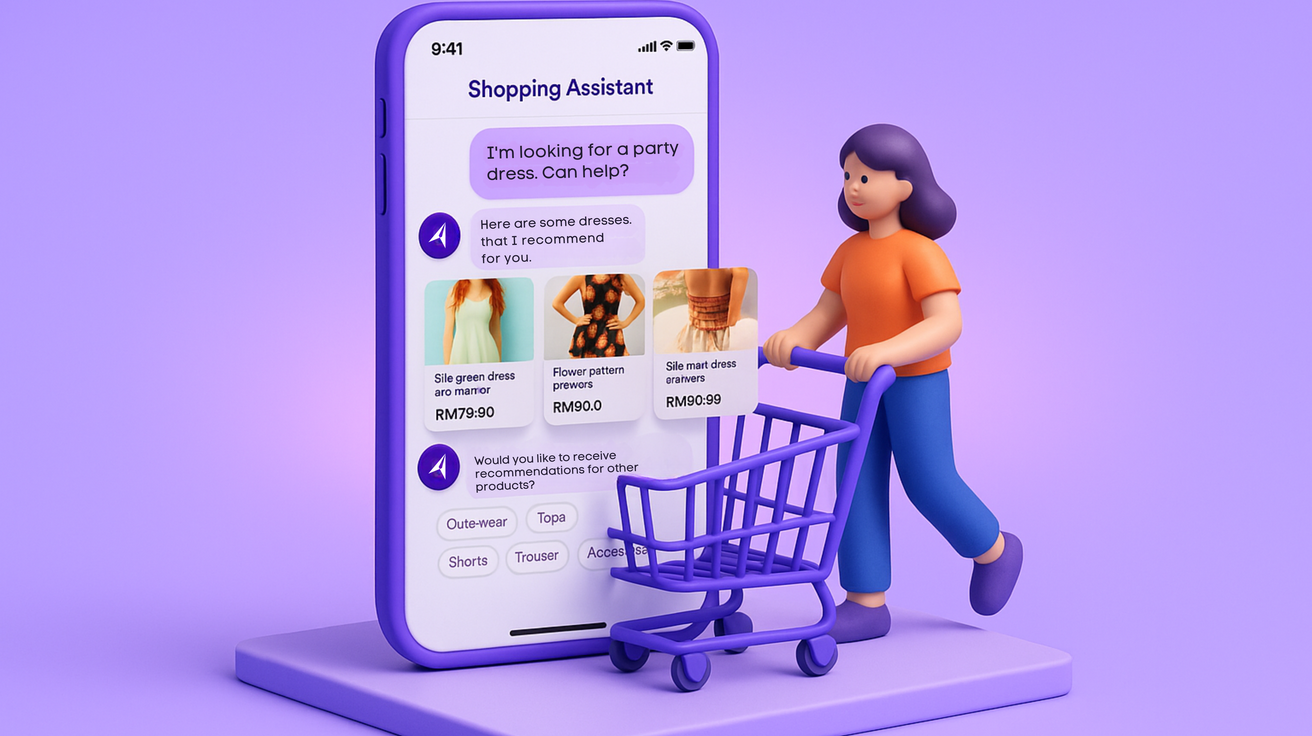
Most conversations about chatbots in retail start with deflection: how many support tickets the bot answers without a human. That is a real saving, but it is the smaller half of the case for an online store. In e-commerce, the same conversational layer sits directly on the path to a sale, and the questions it handles are the ones that decide whether a basket becomes an order.
That changes what a good deployment looks like. A support bot is judged on resolution rate. A commerce bot is judged on whether it helped someone find the right product, answered the objection that was holding them back, and did not get in the way at checkout. Those are different jobs, and they need different design decisions.
Product Discovery and Guided Selling#
Search and category filters assume the customer already knows the vocabulary of your catalogue. Plenty do not. They know the occasion, the budget, the room, the skin type, or the machine the part has to fit, and they have to translate that into whatever facets the site happens to offer.
Recommendations That Use the Conversation#
A recommendation engine working from browsing history infers intent from behaviour. A conversational layer can simply ask. Two or three questions about purpose, constraint and budget narrow a catalogue faster than a filter panel, and the answers are stated rather than guessed.
The practical requirement here is unglamorous: the bot can only recommend what your product data describes. If attributes are missing, inconsistent between suppliers, or buried in free-text descriptions, the model will produce fluent suggestions that do not hold up. Product data quality sets the ceiling on this long before the model does.
Considered Purchases and Comparison#
The higher the price and the longer the consideration, the more the customer wants to compare. This is where a conversational assistant does something a static comparison table cannot: explain the difference in terms of the use the customer described, rather than listing every specification and leaving them to work out which ones matter.
It is also where restraint matters. A bot that steers every conversation toward the highest-margin item is quickly recognised as doing so, and the trust it costs is worth more than the uplift. Recommendations should be defensible against the stated requirement.
Pre-Purchase Questions and the Cart#
The Questions That Decide a Sale#
Delivery timing, stock at a particular size, whether an item fits a model the customer already owns, return terms, warranty scope, duties on a cross-border order. These are not support questions in the usual sense. They are the last unresolved item before a purchase, and they are frequently asked outside working hours.
Answering them in the moment is where a chatbot pays for itself in commerce. The value is not the handling time saved, it is the order that would otherwise have waited for a reply that arrived the next morning, by which point the customer has often bought elsewhere.
Abandoned Carts and When to Intervene#
Cart abandonment is the obvious use case and the easiest to get wrong. A message triggered on a timer, with a discount attached, treats every abandonment as a price objection. Most are not. Shipping cost revealed late, an account requirement, an unclear return policy, or simple comparison shopping account for a large share of them.
A conversational follow-up can ask what stopped the purchase and act on the answer, which also produces something a timed reminder never does: a record of why carts are being left. Two things keep this from becoming a nuisance. Contact people once, on the channel they already opted into, and make the message answerable rather than a one-way push.
After the Order Is Placed#
Post-purchase contact is the highest volume and the most repetitive part of most retail support queues. Where is my order, can I change the delivery address, how do I start a return, has my refund been processed.
These are worth automating precisely because they are deterministic. The answer comes from the order management or logistics system, not from the model, and the conversational layer is only the interface. Design them as tool calls against your systems with the model handling the phrasing, not as something the model is asked to reason about. Anything that moves money or changes a fulfilment commitment should reach a person, or at minimum require an explicit confirmation step.
Getting this right has a direct commercial effect beyond cost. Order status enquiries are the moments a customer is most likely to be anxious, and a fast, accurate answer at that point does more for repeat purchase than most of what sits in the marketing budget.
What the Transcripts Tell Merchandising#
The part usually left unused is the conversation log. In a store, it is a continuous record of demand in the customer’s own words: the products people asked for and could not find, the attributes they searched by that your taxonomy does not carry, the objections that recur before checkout, and the sizes and variants requested most often when out of stock.
Reviewed on a regular cadence, that feeds merchandising, product data, and page copy rather than just the support backlog. A question asked repeatedly before purchase usually belongs on the product page, and once it is there the bot has fewer of them to answer.
Where the Limits Are#
Three things constrain how far this goes. The bot is bounded by product and order data, so integration work and data hygiene are the bulk of the effort rather than the conversational design. Handover to a human has to be early and easy, because a customer with money in hand has little patience for a loop. And the automated path has to be honest about what it does not know, since a confidently wrong answer about stock or delivery costs a sale and a return.
None of that argues against deploying one. It argues for scoping the first release around a few high-volume, well-instrumented journeys, measuring against sales and repeat purchase rather than deflection alone, and expanding from there.
Working out which journeys to automate first, and what has to be fixed in your product and order data before any of it holds up, is the kind of session we run in our hands-on ELEVATE-AI workshop. There is more on conversational deployments and the systems behind them in our Infra Modernisation hub.
As an AWS Premier Partner with the AWS Generative AI competency, we build this inside your own AWS account, connected to your existing catalogue and order systems. If you want to look at your own store and where a conversational layer would earn its place, book a discovery call.