Smarter Meal Delivery: How AI and Cloud Improve Personalization at Scale
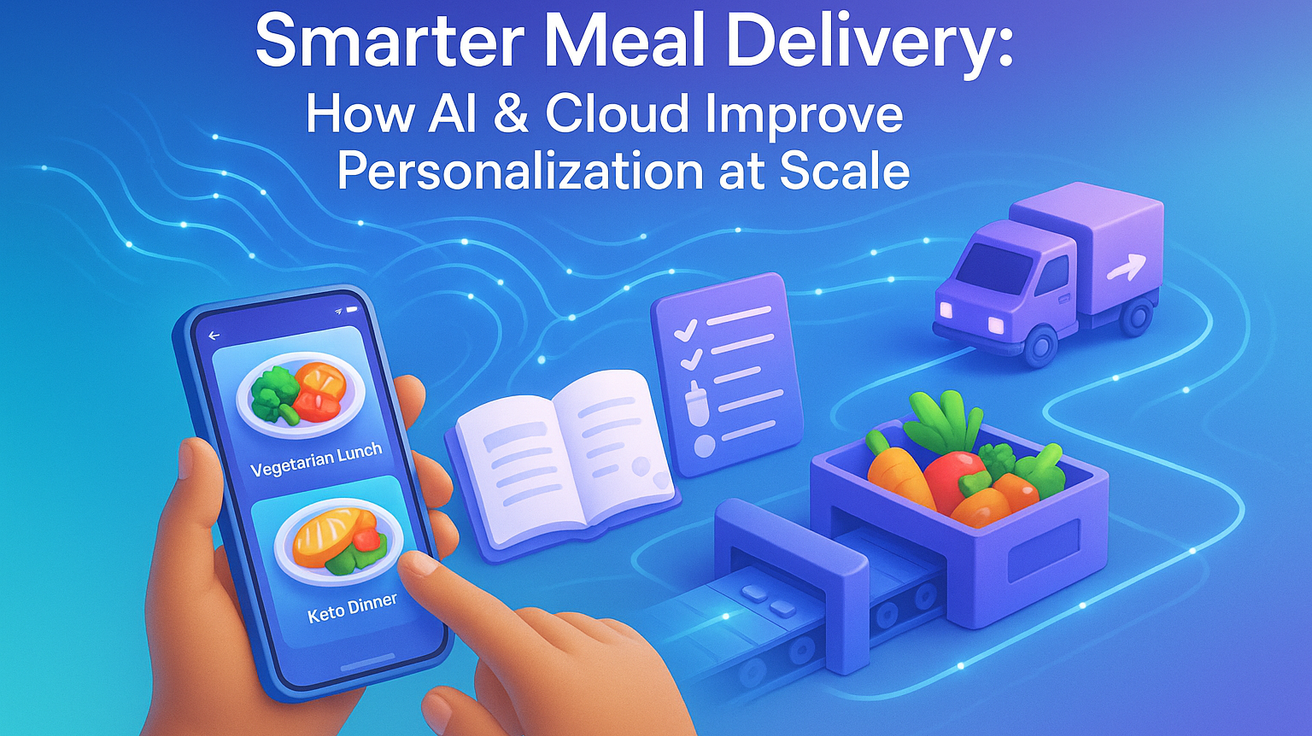
For a growing number of households, food is no longer only about nutrition. A weekly meal plan sits at the intersection of convenience, health goals, family schedules and personal preference, and the service that wins is usually the one that removes the planning rather than the cooking.
Whether it is a vegetarian lunch on Tuesday or a low-carb dinner on Friday, people want food that fits their lifestyle without the overhead of deciding, shopping and second-guessing. That expectation is what personalized meal delivery services exist to meet.
Meeting it at scale is the hard part. Behind every box, the operator has to coordinate recipe planning, ingredient sourcing, inventory, packaging, cold-chain logistics and customer experience. Most of those decisions have to be committed days before the customer confirms anything, and a wrong call shows up as spoilage, a substitution or a cancelled subscription.
The platforms that handle this well tend to share two things: cloud infrastructure that keeps operational data in one place, and AI agents that act on that data rather than simply reporting on it.
The Data-to-Dinner Pipeline#
When you subscribe to a meal kit service, the experience can look like magic. Your preferences are remembered, the weekly menu feels close enough to right that you do not edit it, and the ingredients arrive fresh and portioned.
Behind that is an integrated set of systems working towards four outcomes:
- A personalized customer experience. Every account sees a menu shaped by what that household has actually ordered, rated and skipped.
- Accurate ingredient forecasting. Purchase orders are placed against predicted demand, not last month’s average.
- Efficient fulfilment logistics. Picking, packing and routing adjust to the orders that were actually confirmed.
- Continuous optimization from feedback. Ratings, skips and complaints feed back into the next planning cycle instead of sitting in a dashboard.
None of these is a single model. Each one is a loop, and the loops only work if the data underneath them is shared. That is the part that usually gets underestimated.
Why Cloud Infrastructure Is the Unsung Hero#
Meal delivery businesses operate across regions, kitchens and fulfilment hubs, often with different suppliers and different demand patterns in each. They need systems that scale with the peaks and still answer questions quickly on an ordinary Tuesday.
Centralized, Real-Time Data#
Instead of scattered spreadsheets and siloed applications, the operational record flows into one cloud repository:
- Customer behaviour, including preferences, past orders and skipped weeks
- Ingredient sourcing, supplier lead times and pricing
- Delivery performance and satisfaction feedback
- Seasonal availability and market trends
Centralization is what makes the full picture visible rather than the individual pieces. It also removes an entire class of argument, because procurement, kitchen operations and marketing are all reading the same numbers rather than three reconciliations of the same numbers.
The practical requirement is freshness. A forecast built on data that lands overnight is fine for procurement planning and useless for a substitution decision at 06:00 in a single kitchen. Most operators end up with both: a batch layer for planning horizons measured in weeks, and a streaming path for the decisions that cannot wait.
Elastic Infrastructure#
A spike in orders over a holiday weekend is an infrastructure problem only if capacity is fixed. Cloud systems scale up and back down with demand, which keeps the peak affordable without paying for peak capacity year-round.
The same elasticity makes experiments cheap. Testing a new menu in one city, or running a second forecasting model alongside the incumbent to compare its calls, does not require a hardware decision. That lowers the cost of being wrong, which in turn makes it reasonable to try more things.
The Role of AI Agents: Not Just Smart, but Proactive#
AI agents sit on top of the cloud data platform and act as decision-makers and coordinators. The distinction that matters is not how sophisticated the model is, but whether the output is a recommendation someone has to read or an action the system takes and logs.
Here is what that looks like in meal delivery.
Personalized Meal Planning at Scale#
By analysing a customer’s ordering history, dietary restrictions, ingredient ratings and behaviour patterns such as repeated skips, an agent can:
- Propose meals that account is more likely to accept
- Balance health, novelty and budget preferences rather than optimizing for one of them
- Generate menus weeks in advance so procurement has something to buy against
The result is that each customer sees a tailored plan rather than a mass offering. The operational benefit is quieter but larger: a menu the customer does not edit is a menu that matches the ingredients already on order.
Inventory Forecasting That Minimizes Waste#
Wasted ingredients are expensive for the business, bad for the environment and visible to customers when a substitution arrives instead of the item on the card.
Agents combine historical demand, weather forecasts and cultural calendars such as Ramadan, Christmas and Chinese New Year to predict:
- How much of each ingredient to order
- Which locations will need more of what
- When to promote a dish and when to withdraw it
Done properly this reduces spoilage, tightens procurement and shrinks the transport footprint. It also changes the failure mode. A forecast that is wrong in a known direction can be hedged with a substitution rule; a forecast nobody trusts gets overridden manually, and the manual override becomes the real system.
Dynamic Recipe and Menu Optimization#
Agents do not only plan for individuals. They learn across the whole book of business.
If a recipe underperforms in one region, the system can propose replacements that use ingredients already in the supply chain. If a supplier is late, it can re-plan the affected menus around what is actually available, which preserves continuity for the customer even when the upstream position has changed.
This is where the cloud foundation pays for itself. Re-planning a menu requires reading supplier status, current stock, customer preference and delivery schedule in the same operation, and that is only fast if those four things live in the same platform.
Scaling Globally Without Losing the Local Touch#
One of the harder problems in meal delivery is expanding operations while preserving personalization. What works in Kuala Lumpur may not resonate in Bangkok or Sydney.
Agents help here because they adapt to local data:
- Regional taste preferences
- Dietary norms, including halal, vegan and low-carb requirements
- Local ingredient availability and supplier reliability
- Delivery logistics shaped by geography and traffic
Using localized data with centralized intelligence lets a business act local and think global without re-engineering the platform for every market. The operating model stays one system; the parameters, suppliers and menus are market-specific. That separation is worth designing for early, because retrofitting it after three markets have each built their own stack is a migration project rather than a configuration change.
Beyond Food: What Other Industries Can Learn#
Even if your business has nothing to do with food, the pattern transfers:
- Subscription services face the same retention problem, where the signal that a customer is about to leave appears in behaviour long before it appears in a cancellation.
- Retail and eCommerce forecast demand, automate logistics and serve dynamic content against the same kind of shared operational record.
- Healthcare and wellness platforms deliver individual plans at scale, with a much higher bar for auditability.
What ties these together is a cloud-first data strategy, agents that act rather than only advise, and a feedback loop that keeps improving the decisions instead of only measuring them.
From Insight to Execution#
The shift worth noticing is that agents have moved from answering questions to running workflows. The same building blocks used to plan a menu are the ones used to run a back-office process:
- Customer service. Handling inbound enquiries, chasing follow-ups and escalating the cases that need a person.
- Accounts payable. Validating supplier documents, matching purchase orders to invoices and posting the result into the ERP.
- Accounts receivable. Tracking overdue payments, issuing reminders and reconciling records against the ledger.
In each case the value comes from the same two ingredients as the meal planning example: a data platform the agent can read reliably, and a clearly bounded set of actions it is permitted to take. Agents fail in production far more often because those boundaries were never defined than because the model was not capable enough.
Final Thoughts: Automation with Intention#
AI and cloud systems are enablers of better customer experience and stronger operations, not ends in themselves. In meal delivery they bring together personalization without micromanagement, speed without chaos, and scale without losing the human touch.
The general lesson holds across industries. Better systems produce better decisions, fewer mistakes and customers who stay, but only where the decisions they automate were understood first. Start with the decision that is expensive to get wrong, make the data behind it trustworthy, then let an agent take it.
Working out which of those decisions to automate first is exactly the exercise we run in our hands-on ELEVATE-AI workshop, and there is more on data platforms and agent design in our Infra Modernisation hub.
As an AWS Premier Partner with the AWS Generative AI competency, we build these systems inside your own AWS account, on your own data. If personalization or forecasting is the constraint in your operation, book a discovery call.