Artificial Intelligence: The Limits and Possibilities of AI Tech
From driver assistance systems to virtual assistants, artificial intelligence has become part of ordinary life. Machines now learn from data, recognise patterns and outperform people at narrow, well-defined tasks. What they cannot yet do is understand a business the way a competent colleague does. That gap, between what AI is genuinely good at and what it is still asked to do, is where most disappointing projects live.
This article looks at both sides: the rewards of applying AI to real work, the risks that come with it, and the practical questions a business should answer before adopting it. The technology moves quickly, so the aim here is to describe the shape of the problem rather than to pin down a state of the art that will have changed by the time you read it.
What Artificial Intelligence Actually Is#
Artificial intelligence is a family of computer techniques concerned with problem-solving, pattern recognition and learning from examples rather than from explicit instructions. It imitates aspects of human intelligence closely enough to take over common tasks: routine customer service, image and document recognition, voice-driven interfaces and similar work.
Its strength is scale. AI systems can read far more data than a person can and surface a decision, a ranking or a prediction from it quickly. Applied to complex systems, from markets to medical records, that produces insight which was previously too expensive to extract. It also means mundane work can be automated so that people spend their time on the parts of the job that actually need judgement.
Its weakness is that it has no understanding of context beyond what it has been shown. A model trained on one population, one document format or one type of customer will behave unpredictably outside those bounds, and it will do so confidently. Knowing how the technology works is what allows an organisation to use it responsibly rather than be surprised by it.
The Different Types of AI Technologies#
It is easy to picture one or two specific examples when artificial intelligence is mentioned. In practice AI comes in several forms, each with its own strengths, costs and failure modes.
Broadly, the field divides into applied AI, which most people encounter as machine learning, and general AI. Applied AI handles specific tasks such as facial recognition or natural language processing. General AI covers the much harder and largely unsolved problem of open-ended reasoning and decision-making.
A few examples of each:
- Applied AI: computer vision, natural language processing, document understanding, robotic process automation
- General AI: artificial general intelligence, broad reinforcement learning agents
Almost everything a business can buy or build today sits in the first category. That is not a limitation to apologise for. Narrow systems aimed at a clearly defined task are exactly the ones that reliably reduce hours of manual work and return faster, more consistent results.
Understanding the Pros and Cons of Artificial Intelligence#
Enthusiasm for AI usually runs ahead of a clear-eyed account of what it costs and where it breaks. Both are worth setting out plainly.
The main advantages:
- AI can automate repetitive processes, which lifts throughput and reduces the cost of routine work.
- Systems can be retrained as new data arrives, so performance improves over time instead of degrading with volume.
- Pattern detection at scale is genuinely useful for decision support, forecasting and anomaly detection.
The main risks:
- Without supervision and clear operating limits, an automated system can act at speed on a wrong assumption and cause real damage before anyone notices.
- Some roles will change substantially or disappear, and the organisations that handle this well plan for redeployment rather than discovering the problem after go-live.
- Inaccurate data or biased algorithms produce decisions that repeat and entrench existing prejudice, and they do it in a way that looks objective because a machine produced it.
None of these risks argues against adoption. They argue for supervision, measurement and the ability to explain why a system produced a given answer.
Using AI to Automate Work#
AI is often assumed to be most valuable on the hardest problems. In practice the clearest returns come from high-volume, rules-heavy work built on numbers and text, the tasks that consume a great deal of staff time without needing much judgement.
Efficiency#
Software works faster than people on structured tasks and does not tire. Work that took days of manual handling can often be turned around in hours, with fewer transcription errors. The value is not that the work disappears but that the people who used to do it move to tasks where their judgement matters.
Lower Running Costs#
Automation also changes the cost profile of a process. An automated pipeline runs continuously without additional headcount, so growth in volume does not translate directly into growth in staffing. Those savings can then fund the work that only people can do.
The honest caveat is that these gains are not free. There is a build cost, an integration cost and an ongoing cost to monitor and correct the system. A business case that counts only the labour saved will overstate the return.
What AI Means for the Global Economy#
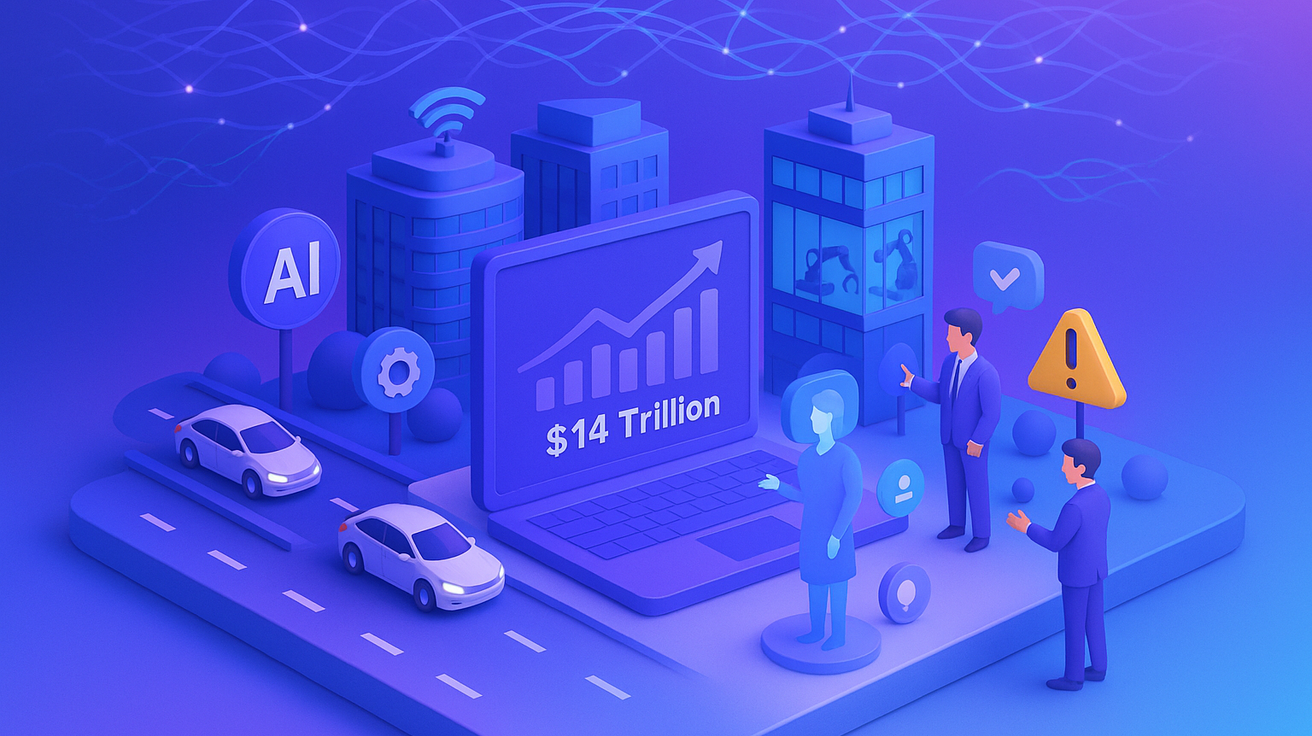
The wider economic effect of AI is contested, and the forecasts should be read as forecasts rather than as facts. According to a study by Accenture, AI could add as much as 14 trillion US dollars to global economic output by 2035. Projections of that kind assume broad adoption, sustained investment and sensible regulation, and any of those assumptions can fail.
What is easier to observe is the direction of travel. Adoption is spreading across finance, retail, healthcare, logistics and the public sector, generally starting with document-heavy and service-heavy processes because those are the ones where the payback is easiest to measure. Countries and companies investing early in skills tend to capture more of the benefit than those buying tools late.
At the same time, real problems remain unresolved: data protection, model transparency, accountability when an automated decision is wrong, and the concentration of capability in a small number of providers. Regulators and technology companies are still working out where the lines sit, and any organisation deploying AI should assume the compliance expectations will tighten rather than relax.
How to Apply AI in Your Business#
Getting value from AI is less about picking the cleverest model and more about picking the right problem. A few things to settle before you start.
Define Your Goals#
Decide what success looks like before you choose a tool. Are you trying to cut handling time, improve service consistency, or understand your customers better? Each of those points at a different technique, a different dataset and a different measure. A project without a defined target will produce a demonstration rather than a result.
Invest in the Right Tools and People#
Once the goal is clear, choose tooling your team can actually operate and maintain, and make sure someone owns it. The skills mix matters more than the brand: you need people who understand your data, people who can integrate systems, and someone accountable for whether the output is correct.
Expect Change#
AI tooling moves faster than most enterprise software. Plan for models to be replaced, processes to be adjusted and staff to need retraining, and build those costs into the budget rather than treating them as overruns.
It is also worth setting expectations on timing. Results are rarely immediate. Most implementations need a period of tuning against real data before the numbers improve, and the organisations that persist through that stage are the ones that see the benefit.
Conclusion#
Artificial intelligence is a capable tool with real limits. It automates work, personalises experiences and improves the consistency of decisions, and it does all of that only as well as the data, supervision and problem definition behind it allow. Understanding those limits before deployment is what separates a system people trust from one they quietly work around.
The practical route in is a narrow, measurable problem, a clear owner and an honest account of both the build cost and the running cost. That is the shape of adoption we work through with teams in our hands-on ELEVATE-AI workshop, and there is more on capability building and governance in our Infra Modernisation hub.
As an AWS Premier Partner with the AWS Generative AI competency, we build this inside your own AWS account so the data and the models stay under your control. If you want to work out which process in your business is the right first candidate, book a discovery call.