Customer Service Pain Points and Where Conversational AI Actually Helps
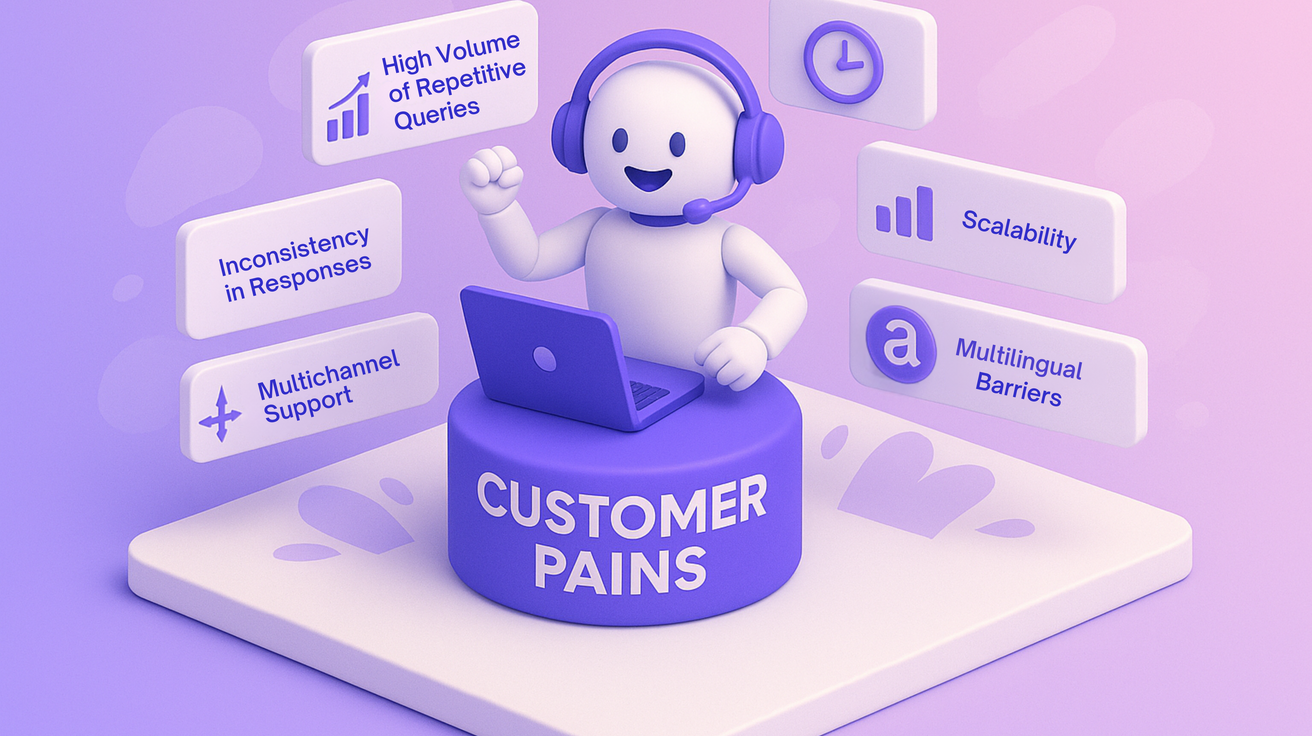
Ask a support manager what is going wrong and you tend to get the same short list, in roughly the same order: too many of the same questions, no coverage outside office hours, no way to grow the team as fast as the ticket volume, and answers that change depending on who picks up the conversation. That list is remarkably stable across industries and company sizes, which is a useful signal in itself. These are structural properties of how support work arrives, not local failures of one badly run team.
Conversational AI is usually sold against that whole list as a single answer. It is not one. Each of those pains has a different shape, and the parts of a support operation that a language model can genuinely absorb are narrower than most pitches suggest. What follows walks through the seven complaints that come up most often, and for each one, what actually shifts when you put a generative assistant in front of the queue and what stubbornly does not.
The distinction is worth getting right before you scope anything, because the pains that respond well to automation are the ones you should be measuring, and the ones that do not are the ones that quietly turn into escalations.
The Volume of Repeated Questions#
The complaint: representatives spend most of the day on a small number of questions asked over and over. Where is my order, how do I reset this, what is the returns window. The work is not difficult, it is relentless, and its cost shows up as attrition rather than as errors.
This is the pain conversational AI addresses most cleanly, because repeated questions have stable answers, and a stable answer is exactly what a retrieval-backed assistant can serve reliably. In most operations a couple of dozen intents account for the large majority of contacts. Automating those removes the bulk of the queue without going anywhere near the hard cases, and it gives the human agents back the part of the job that is actually interesting.
Two cautions. Deflection is not resolution: a bot that answers and leaves the customer unsatisfied has moved the contact to another channel rather than removed it, so track resolution rather than containment. And repeated questions are often a symptom. If order status dominates your inbox, the underlying defect is a tracking page nobody can find. Automating the answer makes the queue shorter and the product no better.
Coverage Outside Business Hours#
The complaint: customers ask at nine in the evening and get a reply at nine the next morning. For a team in one timezone serving customers in several, a large share of contacts arrive when nobody is on shift, and the delay compounds because overnight arrivals land on top of the morning volume.
An assistant that is always available genuinely changes this, and the effect is larger than the raw resolution rate suggests. Even where the assistant cannot resolve the issue, it can acknowledge it, gather the details a human will need, and set an expectation. A customer who has been told what happens next behaves very differently from one who has been met with silence.
What does not change is the shape of the escalation. Anything the assistant hands off overnight still waits for a person, so plan the morning triage queue deliberately. Teams that skip this find they have replaced a backlog of unanswered questions with a backlog of half-handled ones.
Growing the Team With the Ticket Volume#
The complaint: support headcount has to track demand, and hiring is slow, expensive, and lumpy. Seasonal peaks are the worst case, because the team you recruit for a peak is idle afterwards and gone by the next one.
Automated handling of the routine tier does decouple contact volume from headcount for that tier, which is real relief at a peak. The caveat is that it does not decouple the complex tier, and complex contacts do not stay a fixed proportion of the total. As the assistant absorbs the easy work, what reaches your agents is denser: harder questions, angrier customers, cases with history. The team gets smaller in headcount terms and more senior in skill terms, and if you plan the first without the second you end up understaffed at exactly the level where mistakes are expensive.
Answers That Vary by Agent#
The complaint: two customers ask the same question and get different answers, because one agent joined last month and another has a private set of notes. Inconsistency erodes trust faster than slowness does, and it makes policy changes almost impossible to roll out cleanly.
A generative assistant grounded in one approved source is consistent by construction. Everyone gets the answer that is in the knowledge base, at any hour, on any channel. That property is genuinely valuable, but note what it depends on. Consistency comes from the grounding, not from the model. Point the same system at three contradictory internal documents and it will produce fluent, confident, inconsistent answers, and it will do so at a scale no human team could match.
So the work this pain actually demands is editorial. Someone has to own the source content, decide what is current, and retire what is not. That job existed before the assistant. The assistant just makes neglecting it visible.
The Same Customer Across Several Channels#
The complaint: a customer starts on the website, follows up on WhatsApp, then emails, and each channel is handled by a different queue with no shared memory. The customer repeats themselves, and the team duplicates work or contradicts itself.
A single assistant serving every channel from the same knowledge and the same conversation history fixes the repetition, and it is one of the more satisfying wins because the customer notices immediately. The integration work is not trivial, though, and it is usually the part that is underestimated in planning. Identity resolution across channels, message formatting differences, and per-channel rate and template rules are all real engineering, not configuration.
Sequence it deliberately. One channel handled well beats four handled partially, and the first channel teaches you most of what the others will need.
What the Conversations Contain#
The complaint: support sits on a large volume of unstructured text describing exactly what customers find confusing, and nobody has time to read it. Insight arrives anecdotally, through whichever complaint a manager happened to hear.
Language models are well suited to this, and it is the most undersold benefit in the whole category. Clustering and summarising conversations at volume surfaces recurring friction that no individual agent would have flagged, because each agent only sees their own share of it. Trends in what customers ask are also an early signal for the product and content teams, often earlier than the equivalent signal in usage data.
Treat the output as a hypothesis rather than a finding. Summarised themes point you at where to look; they do not establish cause, and they will over-represent whatever is easy to phrase as a question.
Support in More Than One Language#
The complaint: serving customers in several languages traditionally means recruiting for language ability alongside product knowledge, in each market, at every level of the escalation path. That is the constraint that keeps most regional support operations from covering the languages their customers actually speak.
This is where generative models depart most sharply from the previous generation of chatbots, which needed a separately built and maintained flow per language. A model handles the languages it was trained on without a parallel build, so adding a language is closer to a content and testing exercise than a hiring one. For teams across Southeast Asia in particular, that changes what is feasible rather than merely what is cheaper.
Be precise about the limits, because this is where over-promising is most common. Quality is uneven across languages, and it is weakest exactly where the training data is thin, which for this region often means the languages you most wanted covered. Mixed-language and code-switched messages are harder still. Your product terminology, unit names and legal wording need translating deliberately and pinning in the knowledge base, or the model will improvise plausible-sounding equivalents. And every language you launch needs a fluent human able to review a transcript sample and take an escalation. What the technology removes is the requirement for a full staffed tier per language, not the requirement for a speaker.
What Determines Whether Any of This Holds Up#
Across the seven, the implementations that work share a few unglamorous properties.
- The knowledge base is owned by a named person and reviewed on a schedule, because grounding quality sets the ceiling on answer quality.
- Escalation is fast, obvious, and carries the full transcript, so a customer never has to start again after being handed to a person.
- Scope starts narrow. Pick the intents you can answer confidently, refuse the rest politely, and widen from evidence rather than ambition.
- Measurement is on resolution and repeat contact rate, not on deflection, which can be improved by simply being worse.
- Someone reads the failures every week. The transcripts where the assistant did badly are the most useful artefact the system produces.
None of that is about model selection, which is the decision teams spend the most time on and which matters least. The difference between a support assistant customers trust and one they route around is almost always in the grounding, the escalation path and the review loop.
Working through this list against your own queue, deciding which pains are structural and which are content problems in disguise, is the kind of session we run in our hands-on ELEVATE-AI workshop, and there is more on conversational AI and support operations in our Infra Modernisation hub.
As an AWS Premier Partner with the AWS Generative AI competency, we build these assistants inside your own AWS account, so your conversation data and your knowledge base stay under your control. If you want to talk through which parts of your support queue are worth automating first, book a discovery call.