Cloud Migration in South East Asia: What Is Actually Driving Adoption
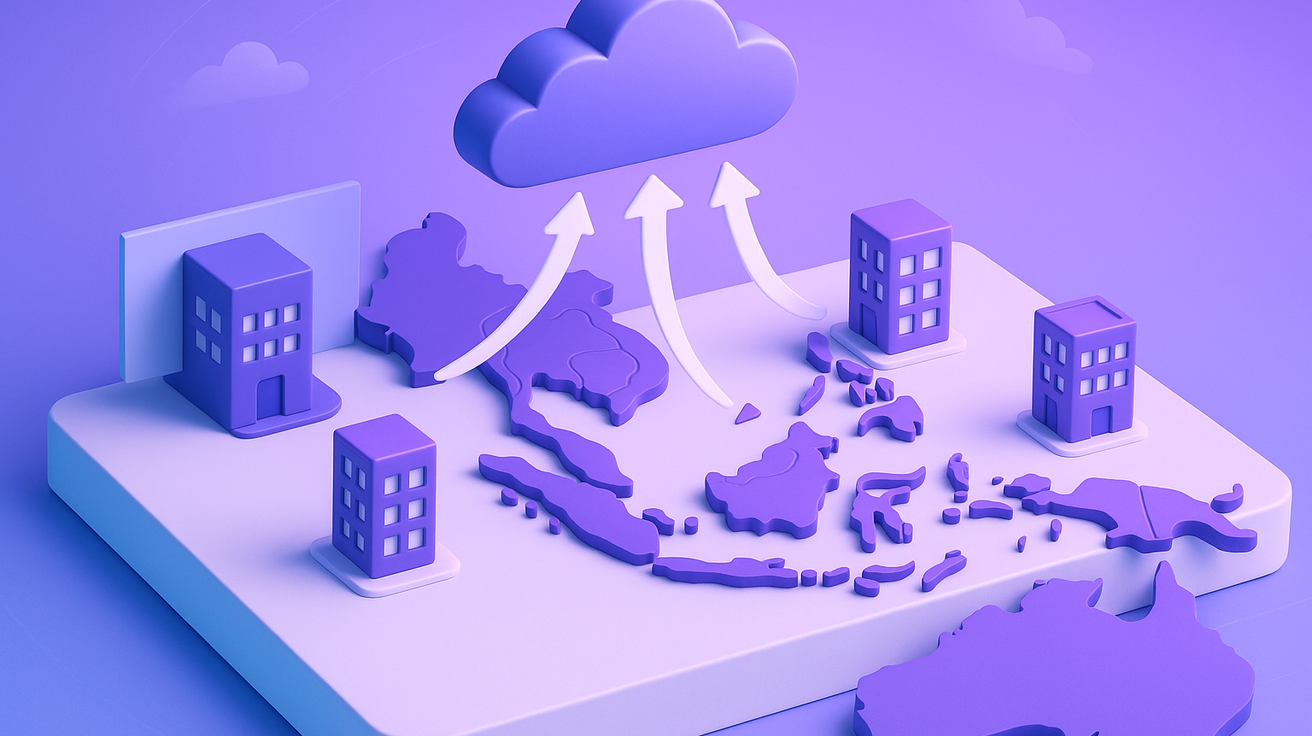
The shift from traditional on-premises infrastructure to cloud-based models is well underway across South East Asia, and saying so is no longer news to anyone planning a migration. The more useful questions are why organisations in this region are moving, which workloads they move first, and why so many of them end up running a hybrid estate rather than the all-in position they set out to reach.
The reasons given are consistent: cost efficiency, scalability and stronger security. All three are real, and all three are more conditional than the headline suggests. This post works through what each one actually depends on, why AWS keeps coming up as the destination, and where migrations in this region tend to get difficult, which is usually Microsoft workloads and long-lived enterprise systems rather than anything exotic.
The Three Drivers, and What They Depend On#
Cost Efficiency Is a Change in Shape, Not an Automatic Discount#
Moving to the cloud swaps capital expenditure on hardware for operating expenditure on consumption. The important consequence is that you stop buying for the peak. A server room sized for the busiest week of the year sits underused for the other fifty-one, and that idle capacity is paid for whether or not anything runs on it.
That trade is strongly in your favour for spiky, seasonal or campaign-driven workloads. It is much weaker for steady workloads already running at high utilisation on hardware you own outright. The pattern that disappoints people is an estate lifted across without resizing: on-premises machines were specified with generous headroom because adding capacity used to take weeks of procurement, and copying those specifications into cloud instances carries the over-provisioning across with them. Cost efficiency comes from right-sizing after the workload lands and from watching consumption afterwards, not from the move itself.
Scalability Matters Most Where Demand Is Uneven#
Scalability is worth the least to a business with flat, predictable load. It is worth the most to one whose demand arrives in bursts it cannot schedule.
That describes a lot of the region. Organisations here commonly operate across several markets at once, each with its own public holidays, retail peaks, payday cycles and regulatory calendar, so the aggregate demand curve is lumpier than any single market would produce. Elastic infrastructure means those peaks are absorbed rather than forecast, and the engineering conversation moves from capacity planning to setting sensible scaling limits and knowing what happens when they are reached.
Security Is Reassigned Rather Than Handed Over#
Cloud platforms operate a shared responsibility model. The provider is responsible for the security of the underlying infrastructure, including physical facilities, hardware lifecycle and the hypervisor layer. The customer remains responsible for what is built on top: identity and access, network boundaries, encryption choices, patching of guest operating systems, and the configuration of every service switched on.
The genuine improvement is that a whole class of work you were doing badly, or not at all, moves to a provider that does it at scale. The risk is assuming the rest moved with it. Permissive access policies and openly readable storage are customer-side mistakes and remain customer-side mistakes after migration. Security improves when a migration is used as the occasion to rebuild identity and network segmentation properly, and improves very little when existing arrangements are copied across unexamined.
Distributed Work Raised the Baseline#
A significant share of regional cloud demand came from organisations having to support staff working away from the office at short notice. The immediate pressure has passed, but the requirement has not, and it turned out to be a structural one rather than a temporary accommodation.
Supporting work from anywhere means identity that functions outside the corporate network, applications that do not quietly assume local network latency, and a security model that stops treating “inside the office” as a proxy for trust. Those are cloud-shaped requirements, which is why the two programmes so often merge. Many organisations built the first version of this under time pressure, with whatever was available, and are now revisiting it as a deliberate architecture rather than an emergency measure.
All-In and Hybrid Are Both Legitimate Destinations#
Some organisations in the region have committed fully to the cloud. Others run a hybrid estate, and hybrid is often described as an interim state on the way to the real answer. Sometimes it is. Often it persists for reasons that are not going to change:
- Data residency and sector rules. Regulation differs country by country, and regulated sectors such as financial services, healthcare and the public sector frequently carry requirements about where data is held and who may access it. Those requirements shape the target architecture, they do not merely add paperwork to it.
- Hardware dependencies. Systems tied to plant equipment, production lines, point-of-sale devices or on-site sensors cannot be relocated independently of the hardware they exist to control.
- Latency to something immovable. An application can move; if it makes constant round trips to a system that cannot, moving it makes the application slower rather than faster.
- Applications near end of life. A system due for replacement within a couple of years rarely justifies the modernisation effort that a clean migration would require.
The distinction worth holding on to is between a hybrid estate that was decided and one that was merely left over. A deliberate hybrid has a named owner per workload, a documented reason for staying, and a date when that reason is reviewed. A leftover hybrid has none of those, and the systems still on-premises are the ones nobody wants to touch.
Why AWS Keeps Coming Up#
The reason is breadth rather than any single service. The catalogue runs from basic networking constructs such as Virtual Private Cloud, through storage, databases and managed application platforms, to machine learning services that need no infrastructure of their own.
That range matters for sequencing more than for feature comparison. It lets an organisation land its existing workloads using infrastructure primitives its team already recognises, then adopt managed services and, later, machine learning capabilities against data that is already in place, without a second migration to a different provider partway through. The regional footprint matters for the same practical reasons as the catalogue: proximity to users, and the ability to choose where data physically sits.
The same breadth is how estates become expensive. Every service is easy to turn on and few are easy to notice afterwards on a consolidated bill. Account structure, resource tagging and clear ownership of spend are much cheaper to establish while the estate is small than to retrofit once it is not.
Microsoft Workloads Are Usually the Hard Part#
Windows Server, SQL Server, Active Directory and .NET applications carry more of the region’s enterprise workload than the general cloud conversation tends to acknowledge, and they are consistently the most demanding part of a migration. The difficulties are specific:
- Licensing. Entitlements and terms are not identical between hardware you own and shared cloud infrastructure. Assumptions carried across unchecked are one of the more common causes of a business case coming apart after the fact.
- Identity. Active Directory is usually entangled with everything else. Moving it, extending it, or replacing it changes authentication for applications, file shares and administrative access all at once, so it belongs early in the plan rather than late.
- Database versions. Older SQL Server versions constrain which managed database options are available, which in turn decides whether a workload can be re-platformed or has to be rehosted as-is.
- Windows-specific assumptions. Hard-coded file paths, scheduled tasks, service accounts and mapped network shares are rarely documented and are reliably discovered during testing rather than during planning.
None of this is unsolvable. It is discovery work rather than execution work, which means it needs to happen before a cutover date is promised to the business, not afterwards.
Legacy Enterprise Estates#
The complexity in an established enterprise migration is rarely inside any one application. It sits in the connections between them: undocumented point-to-point integrations, overnight batch jobs, scheduled file transfers, and reports that quietly read from a database they were never meant to touch.
The migration plan is therefore only as reliable as the dependency map underneath it, and the map is usually less complete than anyone expects at the start. The practical approach is to start where the current architecture causes the most pain and the blast radius is smallest, prove the operating model on that workload, and let the second migration be argued from what was measured during the first.
Decisions like these, which workloads move, which stay, and in what order, are what we work through in our hands-on ELEVATE-AI workshop, and there is more on cloud and platform choices in our Infra Modernisation hub.
Our AWS-certified team migrates Microsoft workloads and enterprise systems off legacy infrastructure, and as an AWS Premier Partner we build inside your own AWS account, so the resulting estate stays yours. If you want to walk through a migration path for your own environment, book a discovery call.