From FAQ Page to AI Chatbot: What Changes in Customer Support
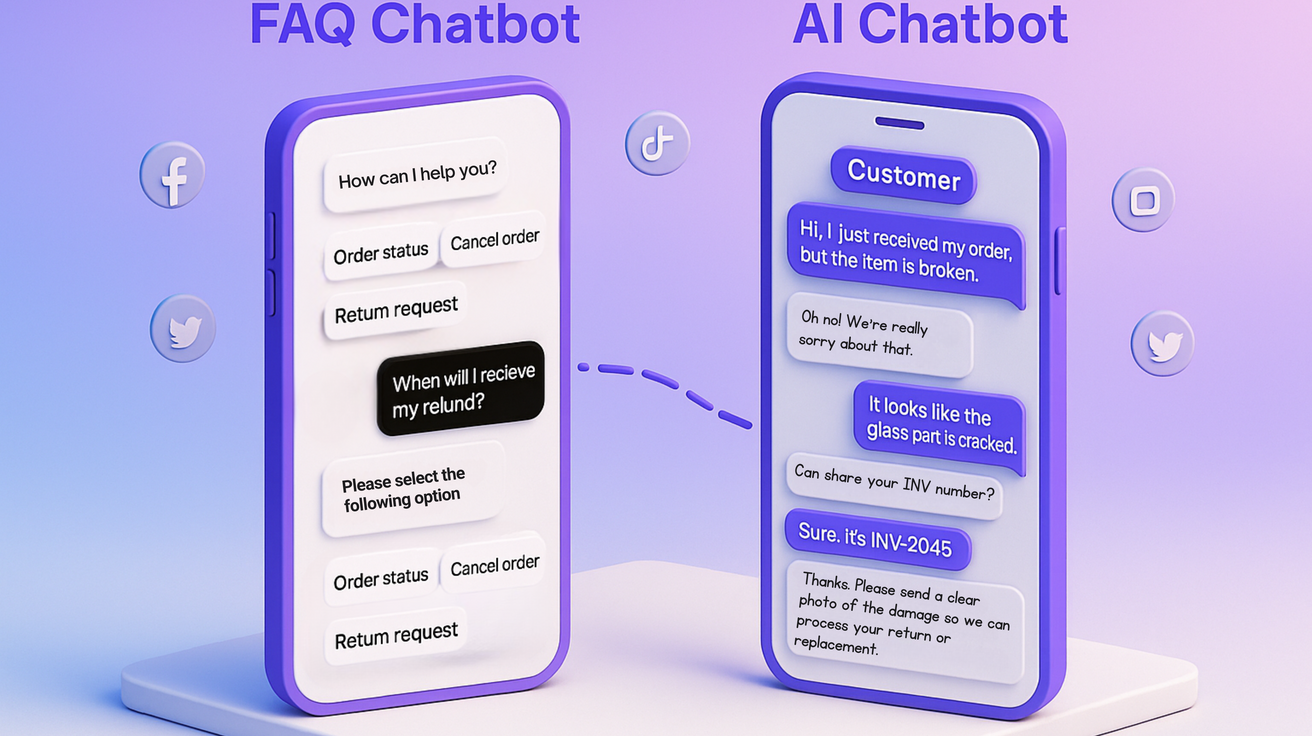
Almost every support operation starts with an FAQ page. It is cheap to write, easy to publish, and it deflects a useful share of the simplest questions. The trouble begins when the page stops being a reference and starts being the front line, because a list of prepared answers can only serve customers whose question was already anticipated by whoever wrote it.
Moving from an FAQ page to an AI chatbot is often described as an upgrade of the same thing. It is not. The two work from different assumptions about who is asking and what they already know, and that difference shows up in maintenance effort, in escalation rates, and in what your support team spends its day doing.
Where a Static FAQ Page Runs Out#
An FAQ answers the questions that someone thought to write down. Customers arrive with the ones nobody did: a question that combines two topics, a follow-up that only makes sense given what they read a paragraph earlier, or a situation specific to their account that no general answer covers.
The failure mode is quiet. The customer does not tell you the page did not help. They open a ticket, call the contact centre, or leave. From the inside this looks like an FAQ page with healthy traffic and a support queue that keeps growing, and the two numbers are rarely connected to each other.
Static content also ages badly. Pricing changes, a policy is revised, a product is retired, and the FAQ keeps confidently stating the old position until someone remembers to edit it. The longer the page grows, the less likely that edit is to be complete.
What an AI Chatbot Does Differently#
An AI chatbot built on your own content does not select from a fixed list of answers. It retrieves the relevant material and composes a reply to the question actually asked. That single change produces several practical differences.
Answers Shaped to the Question#
A customer asking whether a policy applies to their specific case gets an answer about their case rather than the general clause, provided the underlying content supports it. Where the system has access to account context, it can go further and reference what the customer already has rather than describing every option in the catalogue.
This is also the point at which to be honest about limits. The quality of the answer is bounded by the quality of the source material. A chatbot pointed at a neglected knowledge base produces fluent, well-phrased versions of out-of-date answers, which is worse than an obviously stale FAQ page because it reads as authoritative.
Handling the Awkward Middle Cases#
Traditional FAQs and rule-based bots do well on bounded, transactional questions and badly on everything either side of them. The awkward cases, where a customer is not sure what they need or the answer depends on circumstance, are exactly the ones that generate long handling times when they reach a human.
An AI chatbot can work through those in dialogue: ask a clarifying question, narrow the situation, then either resolve it or hand over with the context already gathered. The handover is worth as much as the resolution, because an agent who receives the question fully framed spends their time solving it rather than reconstructing it.
One Set of Answers Across Channels#
An FAQ page lives on the website. Customers do not. They arrive through web chat, WhatsApp, social channels, and email, and each of those tends to accumulate its own separate set of prepared replies that drift apart over time.
A chatbot working from one retrieval layer gives the same answer regardless of the channel it was asked through, and a correction made once takes effect everywhere. In practice this consistency is often the clearest operational gain, ahead of anything the model itself does.
Where Human Agents Still Belong#
The point of this is not to remove agents from the process. Empathy, judgement, negotiation, and anything with a financial or legal consequence should reach a person, and the design work is deciding where that line sits rather than pushing it as far as it will go.
The arrangement that holds up is a conversational layer taking open-ended questions and routing, deterministic flows behind it for actions that must be exact, and a clear, low-friction path to a human that the bot takes early rather than after several failed attempts. A bot that will not let go of a conversation it cannot finish costs more goodwill than it saves in handling time.
Reading the Transcripts#
The part most often skipped is the one with the longest payback. Every conversation is a record of what customers actually wanted, in their own words, including the questions your FAQ never had a section for.
Reviewed regularly, that record tells you which content is missing, which answers are ambiguous enough to generate follow-ups, and which product or process problems are being reported as support questions. This is where the FAQ page earns a second life: not as the customer-facing front door, but as source material that the transcripts tell you how to improve.
Deciding where the deterministic boundary sits, and what content has to be fixed before any of this is worth deploying, is the kind of work we go through in our hands-on ELEVATE-AI workshop. There is more on conversational AI and deployment patterns in our Infra Modernisation hub.
As an AWS Premier Partner with the AWS Generative AI competency, we build this inside your own AWS account, on your own content and systems. If you want to review your current FAQ and support flow and what moving it would involve, book a discovery call.