Bridging the Language Gap in Multilingual Customer Service
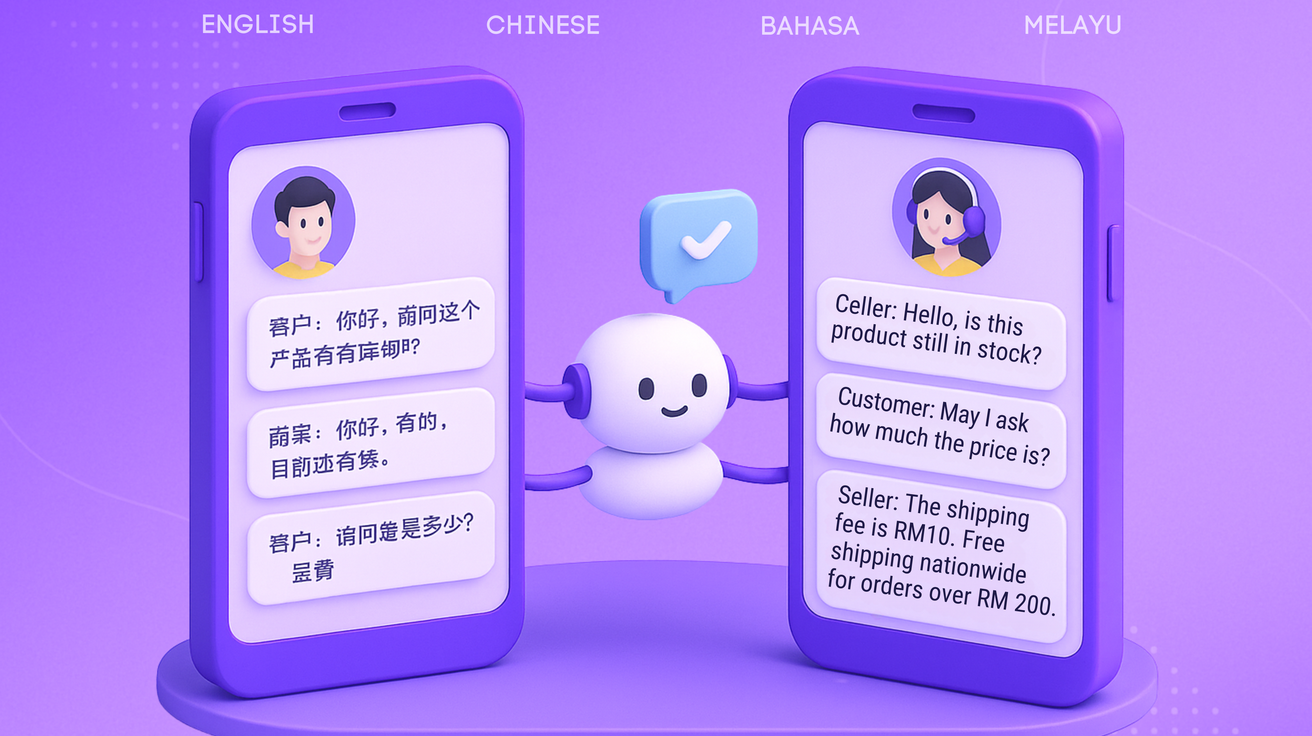
A support queue in Kuala Lumpur or Singapore rarely runs in one language. The same inbox carries English, Bahasa Malaysia, Mandarin and Tamil, and it is common for a single conversation to move between two of them, because that is how people here actually talk. Multilingual support began as a courtesy. For anyone selling across South East Asia it is now a basic operating requirement.
The usual framing treats this as a translation problem, which understates it. Translation handles the words. What breaks a support conversation is everything around the words: regional dialect, mixed scripts, English product terms sitting inside a Malay sentence, a customer typing romanised Mandarin because their keyboard is set to English. An assistant can translate cleanly and still miss what the customer wanted.
Where the gap actually shows up#
The cost of a language gap is rarely a dramatic failure. It accumulates quietly, in three places.
Misunderstanding, then rework. An agent working in their second language reads the ticket slightly wrong, answers a nearby question, and the customer replies to correct them. Two extra exchanges per ticket is not a crisis, but multiplied across a queue it is a real share of your handling time, and it is invisible in a dashboard that only counts resolved tickets.
Customers who stop asking. People who do not feel they can explain their problem in the language they think in tend to give up on the support channel rather than struggle through it. They do not complain. They churn, or they escalate somewhere public, and the support metrics look fine throughout.
Reputation in specific communities. Language coverage is read as a signal of who a company considers a customer. A brand that answers fluently in English and awkwardly in Tamil is making a statement it did not intend to make.
Four languages, one queue#
The South East Asian case is harder than the generic multilingual case for reasons worth naming.
- Code-switching is normal, not an edge case. A sentence that starts in Malay and finishes with an English product name is ordinary usage. Systems built around a single detected language per conversation handle this badly.
- Script is not a reliable signal. Mandarin arrives in simplified characters, in Pinyin, and in a mix of both. Tamil arrives in Tamil script and in romanised form. A detector that reads the alphabet is only reading the keyboard.
- The local variants matter. Manglish and Singlish carry particles and shortenings that are perfectly clear to a local agent and opaque to a model trained mostly on formal text.
- Training data is unevenly distributed. English and Mandarin are extremely well represented in the corpora behind current language models. Bahasa Malaysia is reasonably represented. Tamil, and particularly Malaysian Tamil usage, is much thinner. This shows up directly in output quality.
Why hiring your way out stops working#
The traditional answer is to staff for it. Recruit agents fluent in each language, route by language, and accept the headcount.
This works until it does not. Coverage has to hold across shifts, so each language needs several people, not one. Attrition in a language you have only two speakers of is an outage. Volume in each language moves independently, so you are either overstaffed in one and underwater in another, or both at once. And adding a market means restarting the whole exercise. The model is sound at small scale and gets expensive and fragile exactly as the business grows into it.
What language models do well, and where they do not#
Current language models genuinely help here, and the honest version of the pitch is narrower than the marketing version.
Quality is not uniform across languages#
No model handles every language equally well, and any vendor who tells you otherwise is describing a brochure rather than a system. The same model that produces natural, idiomatic English can produce stilted Bahasa Malaysia and noticeably weaker Tamil, and the gap widens on domain-specific vocabulary such as billing terms, insurance wording or product names. Treat per-language quality as something you measure on your own content, not something you inherit from a benchmark.
Detection is a decision, not a fact#
Language identification on a short, code-switched, romanised message is a probabilistic call. Build the system so a wrong call is recoverable: let the customer switch language explicitly, keep the choice visible, and do not lock a conversation to whatever the first message looked like.
Terminology is yours, not the model’s#
Your plan names, error codes and policy terms are not in any general training corpus. Left alone, a model will translate them, which is the one thing you do not want. This is solved with a maintained glossary of terms that must pass through untouched, per language, owned by someone.
Evaluating before customers do#
The difference between a multilingual assistant that helps and one that quietly annoys people is almost entirely evaluation discipline.
- Build a test set per language from real tickets. Not translated English tickets. Actual Malay, Mandarin and Tamil messages from your own history, including the messy ones.
- Have a native speaker review the output. Fluency scores and automated translation metrics will not tell you that an answer is technically correct and reads as rude, or that the register is wrong for a customer complaint.
- Report metrics per language, never pooled. A pooled containment rate dominated by English volume will hide a Tamil experience that is failing. Separate numbers are the whole point.
- Set a different bar per language if you have to. It is more honest to route Tamil to a human by default while quality is unproven than to ship it and hope.
- Re-run the evaluation when anything changes. A model version change can move quality in one language and not another.
Patterns that hold up in production#
- Ground answers in your own knowledge base rather than the model’s general knowledge, then answer in the customer’s language. Retrieval in English with a translated response is often better than trying to maintain four parallel knowledge bases.
- Make the handover to a human explicit and easy, and make it easier in the languages you trust least.
- Log the detected language, the response, and whether the customer had to rephrase. The rephrase rate per language is one of the more useful early warnings you will get.
- Keep a human in the review loop for a defined period after launch in each language, rather than declaring the rollout finished when English looks good.
Handled this way, multilingual support stops being a staffing problem you cannot win and becomes a system you can measure and improve one language at a time. The gain is not that a model speaks every language perfectly. It is that coverage no longer depends on who happens to be rostered on.
Designing that evaluation loop, the glossary behind it and the escalation rules that decide when a human takes over is the work we go through with teams in our hands-on ELEVATE-AI workshop. There is more on grounding, evaluation and conversational deployments in our Infra Modernisation hub.
As an AWS Premier Partner with the AWS Generative AI competency, we build this inside your own AWS account, with your own ticket history as the evaluation set. If you want to work through what your queue actually looks like language by language, book a discovery call.