The Combined Power of AI Chatbots and Human Agents
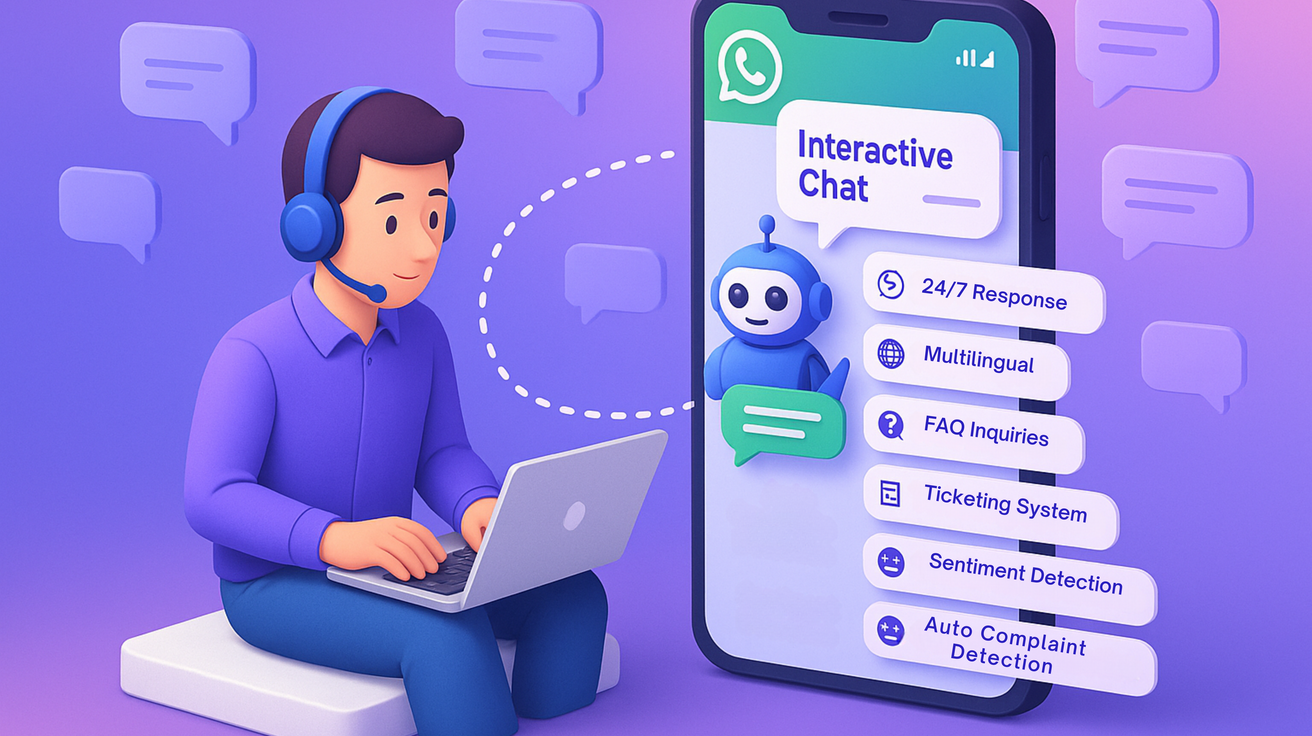
Most support teams do not get to choose between people and automation in the abstract. They inherit a queue, a headcount, a set of channels and a response-time target, and then have to decide what an AI chatbot should take off the top and what has to stay with a human agent. That split is the real design decision, and it is the one that determines whether the deployment helps.
The blended model, where an AI chatbot and human agents work the same queue with a defined boundary between them, has become the default for a reason. Each side is good at something the other handles badly, and the failure modes of running either one alone are well documented by now.
The Challenge of Striking the Right Balance#
The question is not how much of the queue can be automated. It is which parts lose nothing when they are automated, and which parts lose the thing the customer actually came for.
Teams that start from a deflection target tend to push the boundary too far and find out through complaints rather than through their dashboard. Teams that start from the conversations themselves, sorted by what a good answer requires, usually end up with a narrower automated scope and a better result. A blended model works when the boundary is drawn on purpose and revisited as the assistant improves.
Pain Points of a Manual-Only or AI-Only Approach#
Running support entirely with people is expensive in the obvious way and wasteful in a less obvious one. A large share of contacts are repeats of the same handful of questions: order status, opening hours, password resets, delivery windows, how to change a booking. Answering those by hand consumes the capacity of the people best placed to handle the hard cases, and it caps service at the hours the team is staffed. Peaks are absorbed by queueing, so the service degrades exactly when demand is highest.
Running support entirely on an AI chatbot fails differently:
- Anything outside its scope produces a fallback message, and repeated fallbacks read as a business refusing to engage.
- Conversations with a financial, legal or emotional dimension get a competent-sounding answer where the customer needed a decision from someone accountable.
- Without a fast route to a person, the customer’s only escape is to start again on another channel, which costs more than the contact would have cost in the first place.
- The transcripts nobody reads hide the documentation gaps that are generating the contacts.
Neither extreme is really a strategy. Both are a decision to stop thinking about the queue.
Why Human Agents and AI Chatbots Work Better Together#
Routine Queries Handled at Volume#
An AI chatbot is well suited to high-frequency, low-consequence questions with an answer that already exists somewhere in your systems. Handled there, they are answered immediately, at any hour, without a queue. The benefit is not only speed for the customer. It changes what the support team opens in the morning: fewer easy tickets, a higher proportion of work that genuinely needs a person.
Empathy and Nuanced Understanding#
Human agents bring what the model cannot: judgement about an unusual case, discretion over a goodwill decision, and the ability to recognise that a customer is upset about something other than the thing they are asking about. Complaints that have already been mishandled once, sensitive circumstances and anything requiring an exception to policy belong with a person, with the earlier conversation attached so the customer does not repeat themselves.
Scale and Out-of-Hours Cover#
Demand does not follow the working day of the team answering it, particularly across time zones. An assistant that can resolve the answerable share of contacts overnight shrinks the backlog waiting at opening time and absorbs seasonal peaks without temporary hiring. What makes this honest rather than merely cheap is telling the customer plainly when the assistant cannot help and when a person will pick it up, and then doing so.
Why a Blended Approach Helps Efficiency and Profitability#
Putting Expert Time Where It Counts#
Support headcount is a scarce, trained resource. Every hour spent restating a delivery policy is an hour not spent on the escalation that will decide whether an account renews. Automating the repetitive layer is worth doing mainly because of what it frees up, not because of what it removes.
Leaner Operations#
Faster first responses, fewer contacts sitting in a queue and less rework from customers chasing the same issue twice all reduce cost per resolved conversation. These gains are measurable in your own service data, and they are worth measuring directly rather than inferring from a vendor’s figures. Track resolution rate and customer effort rather than deflection: deflection counts every conversation that ended, including the ones where the customer gave up.
Design the Handover, Not Just the Bot#
The blended model lives or dies on the transition between its two halves. A handover that drops the transcript, loses the customer’s order context or lands them at the back of a queue undoes whatever the automated part saved. Make the route to a person visible rather than hidden behind repeated attempts, pass the full conversation into the agent’s view, escalate on request without a confirmation loop, and read the escalated transcripts weekly. They are the clearest signal available of where the boundary is currently drawn wrongly.
Redefining Customer Support with a Blended Model#
Treating this as a choice between an AI chatbot and human agents produces the worst of both. Treated as a single service with two kinds of capacity and a deliberate boundary, it produces faster answers on the routine layer and better attention on the cases that need it.
Working out where that boundary sits in your own queue, and building the handover that makes it work, is the kind of problem we take apart in our hands-on ELEVATE-AI workshop, and there is more on assistants, grounding and deployment patterns in our Infra Modernisation hub.
As an AWS Premier Partner with the AWS Generative AI competency, we build these assistants inside your own AWS account, on your own support data and systems. If you want to review which parts of your queue this suits, book a discovery call.