Four Eras of Customer Service: From Call Centres to Generative AI
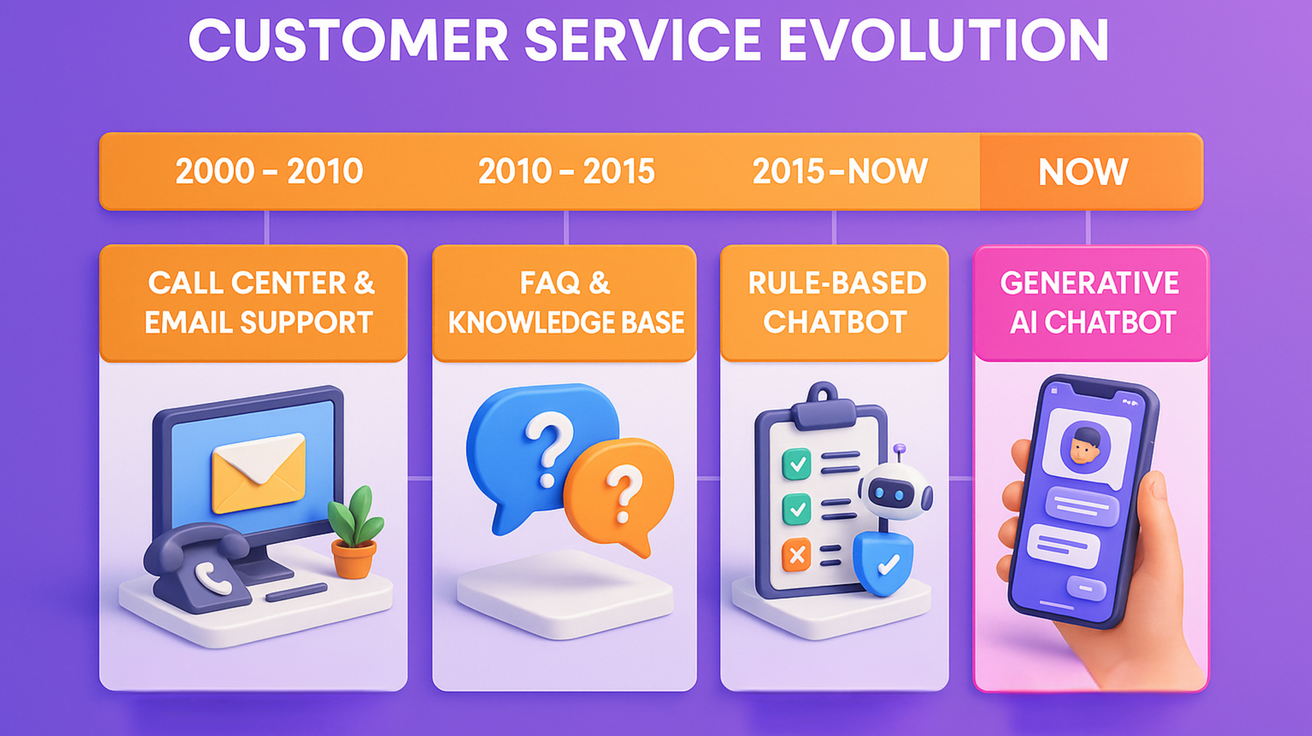
Customer service has been rebuilt roughly once every five to seven years since the year 2000, and each rebuild followed the same logic. A channel reached the limit of what it could handle, the cost of staffing around that limit became untenable, and a new layer of technology was added on top rather than in place of the old one. Most support organizations today are still running all four generations at once.
Reading that history as a straight line of improvement misses the more useful point. Each era was constrained by the same thing: somebody had to anticipate the customer’s question in advance, and the difference between the eras is only who that somebody was and how far ahead they had to think. Understanding where that burden sat explains why every previous generation plateaued, and it is the clearest way to judge what generative AI actually changes.
In September 2023, Sepang International Circuit launched a customer-facing chatbot built on generative AI, which is a reasonable marker for when this shift stopped being a pilot exercise in this region and started appearing in production. What follows is the arc that led there, era by era, and what each one left unsolved.
2000 to 2010: Call Centres and Email Queues#
At the turn of the millennium, customer service meant a phone number and an inbox. Both were staffed by people, and both scaled in exactly one way: by hiring more people. Customers valued the direct contact, but they paid for it in queue time, either holding on a line or waiting days for an email reply.
The anticipation burden here sat with the agent, in real time. Nobody had to predict questions in advance, which is why this model could handle almost anything a customer threw at it. That flexibility was also its ceiling. Every additional question needed another minute of a paid person’s attention, so capacity, cost and quality moved together and could not be separated.
Where it broke: technical support hotlines#
Technology companies leaned hardest on this model because their queries were the least predictable. The result was the long hold time that became a cultural reference point. The damage was not only the wait. Customers who eventually reached an agent had already spent their patience, so the conversation started from a deficit, and repeat contacts on the same issue multiplied the cost of the original failure.
2010 to 2015: FAQ Pages and Knowledge Bases#
As search became the default way people looked for anything, businesses moved the answers to where customers were already looking. FAQ pages and structured knowledge bases let customers resolve common issues without contacting anyone, which took real volume out of the call queue for the first time.
This moved the anticipation burden from the agent to the author. Someone now had to predict, in advance and in writing, every question worth answering. That works well for a stable, well-understood set of issues and fails in two predictable ways: questions nobody thought to write up, and questions that were written up but phrased differently by the customer searching for them.
Where it broke: online retail#
E-commerce businesses built some of the most extensive knowledge bases of this era, covering product specifications, delivery timelines and returns. They still could not cover the combinations. A question about a specific item, ordered under a specific promotion, delivered to a specific address, is not a knowledge base article. It is an intersection of three of them, and the customer had to do the joining.
2015 to the Early 2020s: Rule-Based Chatbots#
Rule-based chatbots put a conversational surface on the knowledge base. Behind an interface that looked like a chat window sat a decision tree with keyword matching, returning a fixed response when the input matched a defined pattern and a fallback message when it did not.
The anticipation burden here doubled rather than lifted. A designer now had to predict both the questions and the phrasings and the paths between them, and that work had to be redone every time the product, pricing or policy changed. The maintenance load is what quietly killed most of these deployments. A tree that nobody has updated in a year is worse than no bot at all, because it answers confidently and wrongly.
Where it broke: travel and hospitality#
Hotels and travel agencies used these bots for booking flows, where a fixed sequence of questions genuinely fits. Inside the flow they worked. One step outside it, a date change, a special request, a query about a booking made through a third party, and the customer hit the fallback message and asked for a human anyway. The bot had added a step rather than removed one, which is where the reputational damage to chatbots as a category came from.
From 2023: Generative AI Assistants#
Generative AI assistants are the first generation where the system handles phrasings nobody wrote down. A model interpreting natural language does not need a keyword to match. It can read an unusual, incomplete or multi-part question, work out what is being asked, and compose an answer rather than select one from a list. That is the specific thing that changed, and it is worth stating narrowly, because it is the only part that is genuinely new.
What this does is move the anticipation burden off the question and onto the answer. Nobody now has to predict how a customer will phrase something. What does still have to be got right is the material the assistant is allowed to answer from, whether it is current, and what happens when the correct response is that it does not know. Ground the assistant in your actual product data, order records and policies and it resolves the intersection questions that defeated the knowledge base era. Leave it ungrounded and it will answer those same questions fluently and incorrectly, which is a worse failure than the fallback message because it does not look like one.
What changes: banking and financial services#
Financial services were among the earlier adopters, largely because their query mix is both high-volume and highly individual. The same question about fees or eligibility has a different correct answer for every customer, which is precisely the shape that neither an FAQ nor a decision tree could hold. It is also the shape that makes grounding and access control non-negotiable, since the assistant is reading account-level data to answer at all.
The Pattern Across All Four Eras#
Set the four side by side and the trend is not really about automation. It is about how far in advance someone has to think.
- Call centres: the agent anticipates nothing, and you pay per conversation.
- Knowledge bases: an author anticipates the questions, once, in writing.
- Rule-based bots: a designer anticipates the questions, the phrasings and the paths, and maintains all three forever.
- Generative assistants: nobody anticipates the phrasing, and the work moves to grounding, boundaries and escalation.
This is worth being clear about, because the failure mode of the current era is treating it as the end of the sequence rather than another step in it. Every previous generation was deployed as a replacement and ended up as a layer, and the same will hold here. The organizations getting value from generative AI in support are not the ones that switched everything off. They are the ones that decided deliberately which questions the assistant owns, which still route to a person, and how a conversation moves between the two without the customer repeating themselves.
What to Do With This#
If you are evaluating where you sit, the useful question is not which era your tooling belongs to. It is where your anticipation burden currently sits and what it costs you.
Look first at your fallback and escalation logs rather than your resolution rate. The questions your current system cannot handle are a direct description of what a grounded assistant would need access to. Second, audit what the answers would be composed from. If your product data, policies and order history are scattered across systems that do not talk to each other, that is the actual project, and no amount of model quality substitutes for it. Third, decide the boundary before launch, not after the first bad answer. An assistant that says it will pass something to a colleague preserves trust. One that improvises spends it.
Working out where that boundary belongs for a specific support operation is the kind of decision we run through in our hands-on ELEVATE-AI workshop, and there is more on grounding, retrieval and rollout in our Infra Modernisation hub.
As an AWS Premier Partner with the AWS Generative AI competency, we build these assistants inside your own AWS account, against your own customer data, with the escalation path defined up front. If you want to map your current support volumes to what an assistant could reasonably take on, book a discovery call.