The Power of AI in Healthcare
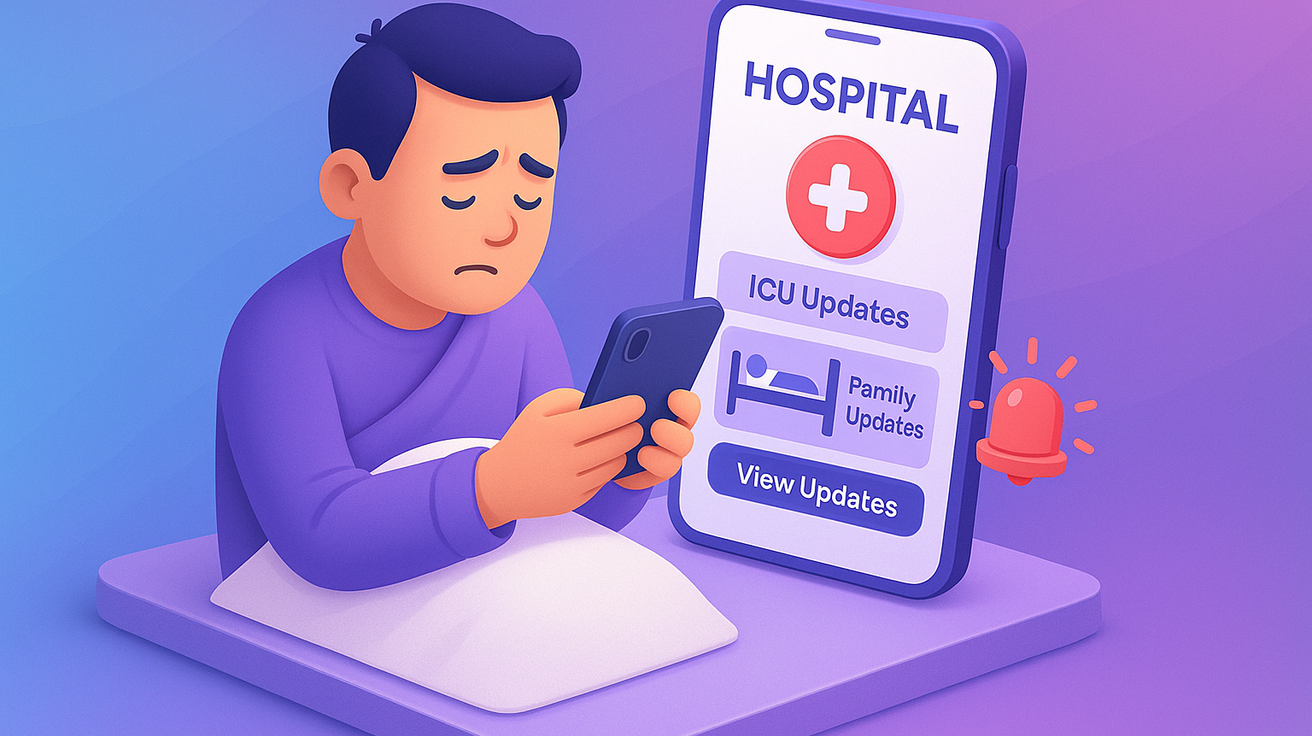
Most of the attention on AI in healthcare goes to imaging and diagnosis. The changes that reach patients and their families first are usually more ordinary than that: how an alert gets raised, how quickly someone answers it, and how a family finds out what is happening. Those are communication and coordination problems before they are clinical ones, and they are where software can help without going anywhere near a clinical decision.
This post looks at one narrow slice of that work. It covers the shift from the physical emergency button at the bedside to an app that can raise the same alert, the coordination that becomes possible once an alert is a message rather than a wire in the wall, and the boundaries a team should draw before building anything of the kind.
From Bedside Button to Connected App#
Replacing the Physical Button#
The nurse call button is a well-understood piece of hardware with two well-understood failure modes. It has to be within reach, and it has to work. A patient with limited mobility cannot always reach a handset that has slipped down the side of the bed, and a failed unit gives no sign that it has failed until the moment somebody needs it.
An app-based alert changes the shape of that problem rather than removing it. The alert can be raised from a phone, so it does not depend on the patient reaching one fixed point in the room, and it can be raised by a family member who is at the bedside or elsewhere in the building. The channel is also observable in a way a sealed switch on a wall is not. A software alert can be timestamped, acknowledged, escalated when nobody acknowledges it, and reviewed afterwards.
That last property is the one worth designing for. Ordinary alerting gives you a signal. A software channel gives you a record of what was raised, when it was seen, and who picked it up, which is what a ward manager needs in order to change anything about how the ward runs.
Instant Connectivity and Status Updates#
Once an alert is a message, the same channel can carry information back. A family member who has raised a request can be told that it has been received, which is the single most common reason for the follow-up phone call to the ward.
The same channel can carry routine, non-clinical status. Whether a patient has gone down for a scheduled procedure, whether they are back on the unit, whether visiting is open. None of that requires interpretation, all of it is currently delivered by a nurse leaving a bedside to answer a phone, and moving it into an app is a straightforward reduction in interruptions rather than a claim about better care.
Be careful with the scope of those updates. Anything that carries clinical meaning, a result, a change in condition, a prognosis, belongs in a conversation with a clinician, not in a push notification. The design question is not how much you can send, it is how little you can send while still making the phone call unnecessary.
Collaboration Between Families and Care Teams#
Virtual Consultations#
A conversational assistant in front of the app can absorb the procedural questions that families ask constantly and that nobody needs a clinician to answer. Where to park. What time the ward opens. What a named procedure involves in general terms. What to bring for a discharge.
The important part of that design is what the assistant refuses. An assistant that offers to interpret a result, suggest a change in medication or estimate a recovery time is doing something a communication tool should not do, whatever the model is capable of generating. The useful pattern is a narrow, retrieval-backed assistant that answers from the hospital’s own published material and routes anything clinical to a named person, with the handover visible to the family so they know a human has it.
Set that boundary in the system design rather than in the prompt alone. Restrict the retrieval corpus to approved content, keep a refusal path that escalates instead of apologising, and log every exchange so the clinical team can audit what the assistant has been telling people.
Secure Information Sharing#
Encryption in transit and at rest is the easy half and should be assumed. The hard half is identity and consent: proving that the person receiving an update is the person the patient agreed should receive it, and having a way to withdraw that access when a relationship changes.
That means a consent record the care team can see and edit, access scoped to one patient rather than one ward, an audit trail of who read what, and a defined retention period. Health data is subject to local protection rules wherever you operate, and those rules generally govern who may access a record and for how long, not merely how it is stored. Treat the consent model as the primary piece of the system and the cryptography as a prerequisite.
Where the Line Sits#
It is worth stating plainly what this class of software does. It coordinates communication between patients, families and care teams. It does not triage, diagnose, interpret results or recommend treatment, and it should not be presented to a hospital as though it might. Clinical judgement stays with clinicians, and anything that would change a clinical decision belongs in the systems and processes already governed for that purpose.
Axrail builds the coordination layer: the alerting, the routing, the retrieval-backed assistant, the consent and audit trail, and the integrations that let those sit alongside existing hospital systems. That is deliberately not a clinical product, and keeping the two apart is what makes the software straightforward for a hospital to assess.
What to Weigh Before Building One#
If you are scoping something in this space, the questions that decide whether it works are mostly not AI questions.
- Fallback. What happens when the phone is flat, the network is down or the app crashes. The physical call button should stay on the wall, and the app should be an additional channel rather than a replacement for the one that works without power.
- Identity and consent. Who is allowed to raise an alert or read an update for a given patient, who grants that, and how it is revoked.
- Who answers. An alerting channel with no owner on the other end is worse than no channel, because it looks answered. Define the rota, the acknowledgement window and the escalation before you ship.
- Alert fatigue. Every additional route into a busy ward competes with the ones already there. Measure how many alerts a shift receives and how many turn out to need a clinician.
- Integration. Existing nurse call systems, the patient administration system and the medical record already hold most of this data. A parallel system that does not reconcile with them creates a second version of the truth.
- Audit. Assume you will be asked to show what the assistant said to a family and what the ward did with an alert. Build the log first.
None of that is glamorous, and all of it decides whether the deployment survives contact with a real ward. The AI in the system is a small, well-bounded part of it, and it earns its place by removing routine questions from people who should be doing something else.
Scoping decisions like these, particularly where to draw the line between an assistant that helps and one that oversteps, are what we work through in our hands-on ELEVATE-AI workshop, and there is more on assistant design and governance in our Infra Modernisation hub.
As an AWS Premier Partner with the AWS Generative AI competency, we build this inside your own AWS account, with the consent, audit and retention controls in place from the start. If you are weighing a patient or family communication project, book a discovery call.