Traditional Chatbots vs AI Chatbots
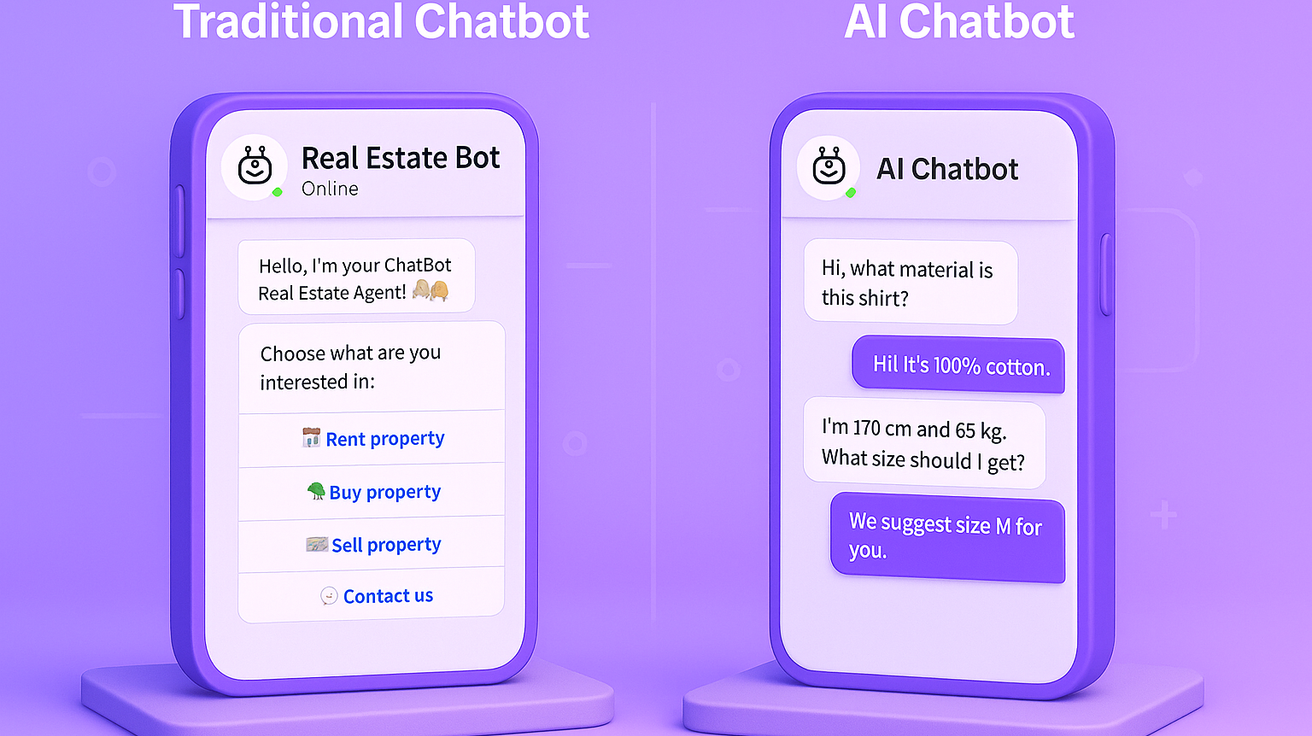
Most organisations that already run a chatbot built it the same way: a decision tree, a list of intents, and a set of canned replies. Generative AI chatbots work from a different starting point, and the difference is not cosmetic. It changes what the bot can answer, how much maintenance it needs, and where it fails.
Below are the five differences that matter most when you are deciding whether to keep extending a rule-based bot or move to a generative one.
Static Responses vs Dynamic Conversations#
Traditional chatbots operate on predefined scripts and return a fixed response when a keyword or intent matches. The interaction is predictable, which is useful, but it reads as robotic the moment a customer phrases something the script did not anticipate.
Generative AI chatbots compose a reply at the point of the request rather than selecting one from a list. The wording adapts to what was actually asked, so the exchange holds together across several turns instead of resetting each time.
Keyword Matching vs Contextual Understanding#
A rule-based bot classifies each message on its own. Ask it a follow-up such as “and what about the second one”, and it usually has nothing to attach that to, so it falls back to a generic reply or restarts the flow.
Generative chatbots carry the earlier turns of the conversation into the current one. Pronouns, corrections, and half-finished questions resolve against what was already said, which removes a large share of the “sorry, I did not understand that” responses customers learn to expect.
Scripted Flows vs Generalisation#
Every question a traditional chatbot can answer has to be anticipated, written, and mapped by a person. Coverage grows linearly with effort, and the flow diagram becomes harder to change as it grows.
Generative chatbots generalise to phrasings nobody wrote down, so coverage does not depend on enumerating every variation in advance. It is worth being precise about what this does not mean: the model is not quietly learning from your customers in production. Improvement comes from updating the knowledge the bot retrieves from, refining its instructions, and reviewing transcripts, which is real work, just a different kind of work from maintaining an intent tree.
Transactional Answers vs Ongoing Conversations#
Traditional chatbots suit transactions: check an order status, reset a password, book a slot. Within that narrow band they are fast, cheap, and easy to reason about.
Generative chatbots handle the messier conversations either side of the transaction, where the customer is not yet sure what they need and the answer depends on their situation. That is usually where the frustrating handoffs to human agents happen today.
Language Coverage#
Supporting an additional language in a rule-based bot generally means rebuilding the intents and responses for that language and maintaining them in parallel. In Southeast Asian markets, where a single customer may switch between languages mid-sentence, that quickly becomes the bulk of the maintenance cost.
Generative models handle multiple languages without a separate script per language, though quality varies by language and still needs checking against your own content rather than assumed.
Where Each Approach Still Fits#
This is not a straight replacement. A rule-based flow is still the better answer for a short, high-volume, strictly bounded task where you need the same response every time and a regulator may ask you to prove it. Password resets and delivery lookups do not benefit from a model composing prose.
The pattern that works in practice is a generative layer handling open-ended questions and routing, with deterministic flows behind it for the actions that must be exact. That way you get conversational coverage without giving up control of the steps that touch a customer’s account.
Choosing between these approaches, and deciding which parts of a support flow should stay deterministic, is the kind of trade-off we work through in our hands-on ELEVATE-AI workshop. There is more on deploying conversational AI in our Infra Modernisation hub.
As an AWS Premier Partner with the AWS Generative AI competency, we build this inside your own AWS account, on your own content and systems. If you want to review your current chatbot and what it would take to move it, book a discovery call.