Why WhatsApp Loyalty Programs Outperform Traditional Apps for Customer Retention
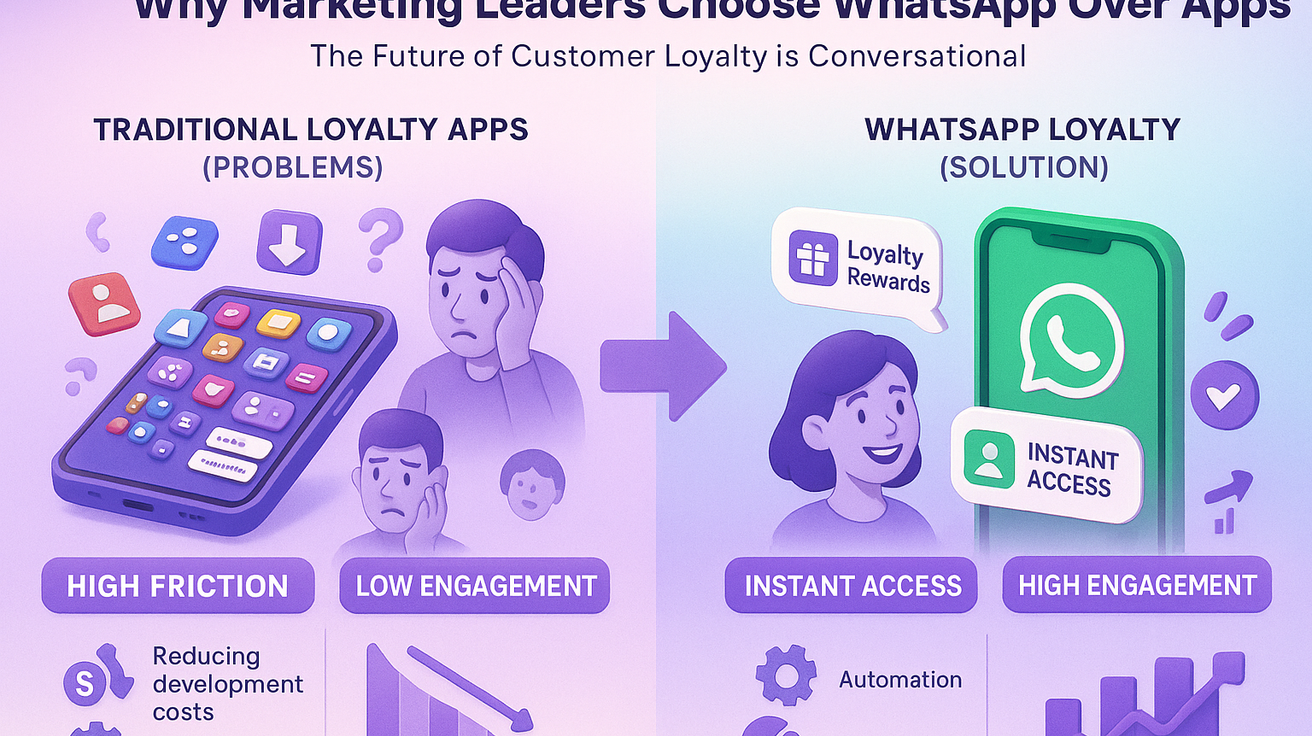
Most loyalty programs do not fail because the rewards are wrong. They fail because customers forget the program exists. A traditional loyalty app asks for a download, an account, a password, and then a reason to open it again next month. Every one of those steps loses people, and the ones who survive all of them still have to compete with everything else on the home screen for attention.
A loyalty program that runs inside WhatsApp removes most of that friction. The customer already has the app installed, already reads the thread, and joins by scanning a code or sending a keyword. For marketing and CRM teams, that changes the economics of retention: less onboarding drop-off, no app store release cycle, and a channel people genuinely open.
This post covers where WhatsApp loyalty outperforms an owned app, where it does not, and what the integration behind it has to do to be worth building.
Why Marketing Leaders Are Moving Loyalty Off the App#
The case for an owned loyalty app was always that it gives you a direct relationship with the customer. In practice, most programs never get far enough to test that. The install is the first filter, registration is the second, and re-opening the app after the first visit is the third. By the time you have a segment worth marketing to, a large share of the people you paid to acquire have already dropped out.
Messaging inverts that funnel. The install has already happened, and it happened for reasons that have nothing to do with your brand. Joining a program becomes a single reply, which means the cost of getting someone into the program collapses to roughly the cost of putting a QR code in front of them.
The second difference is attention. A push notification lands in a queue alongside every other app on the device and is easy to disable permanently. A WhatsApp message lands in the same list as messages from family and colleagues. That reach is an advantage and a liability at once: it works because the channel is trusted, and it stops working the moment you spend that trust on messages nobody asked for.
WhatsApp Loyalty vs Traditional Loyalty Apps#
The comparison that matters to a CRM owner is not feature-by-feature. It is where the effort goes and where the customers go.
| Aspect | Traditional loyalty app | WhatsApp loyalty program |
|---|---|---|
| Joining | Download, install, register an account | Scan a QR code or send a keyword |
| Onboarding drop-off | High, and most of it happens before first use | Low, the customer is already in the app |
| Reach | Push notifications compete with every other app | Messages arrive in a thread people already read |
| Build and upkeep | Two native codebases, store releases, ongoing maintenance | Conversation flows and message templates on an existing channel |
| Personalization | Usually a custom integration project | Driven from the CRM data the business already holds |
| Redemption | In the app, or at the point of sale only | In the thread, with a code staff can scan |
The row that surprises people is build and upkeep. An app is not a one-off cost: it is two platform builds, a release process, and a permanent maintenance obligation as operating systems move underneath it. A messaging program moves that spend into flows and templates, which non-engineers can change, and into the integration layer, which is where the engineering effort belongs.
What This Looks Like in Practice#
The pattern is consistent across sectors even though the trigger and the reward differ.
Retail Chains#
The problem is familiar: customers install the app once at the counter to claim a discount, then never open it again, and CRM campaigns to that list perform poorly because the list is mostly dormant accounts.
Run on WhatsApp, the flow is a QR code on the receipt or at the till that opens a chat. One message enrols the customer. Points accrue against transactions from the point of sale, offers are shaped by spend frequency and store location, and customers who have not been seen for a month get a message rather than a notification they never enabled.
Teams that make this switch generally see better engagement than their email campaigns and more repeat visits, but the size of that lift depends on the offer and on how weak the baseline was. Treat any figure a vendor quotes, ours included, as a hypothesis to test rather than a forecast.
Food and Beverage Chains#
Here the constraint is usually time of day rather than total footfall. Lunch is busy, the evening is not, and SMS campaigns aimed at filling the gap bounce or get ignored.
Enrolment happens after an order. Points accrue per transaction automatically. Scheduled campaigns push evening offers at the hour they can still change a decision, and customers who have not ordered in a fortnight get a targeted re-engagement message. The advantage over SMS is not just deliverability, it is that the customer can reply, which turns a broadcast into a booking.
Beauty and Wellness#
Rebooking is the whole business, and it is exactly what app reminders are worst at. A post-visit thank-you message goes out automatically, carrying the loyalty points earned and a rebooking link. A follow-up lands a month later, timed against the service the customer actually had, because the flow is reading the booking system rather than guessing.
The measurable win in this sector tends to be fewer no-shows rather than more bookings, which is worth knowing before you set the target, because the two need different messages.
Making It Work: The Integration Layer#
Everything above depends on the program not being a standalone toy. A chatbot that keeps its own points ledger is a second source of truth that will disagree with your CRM within a month. The integration is the product.
At minimum, a WhatsApp loyalty program needs to connect to the systems you already run, typically CRM, point of sale, and in larger operations ERP, so that:
- Behaviour-based automations can fire on real events, such as rewarding a high spender or re-engaging a lapsed customer, rather than on a schedule
- Messaging can be personalized from the customer’s actual history and location, not from a tag someone set manually and forgot
- Points balances and customer profiles stay in sync in both directions, so the balance quoted in a chat is the balance honoured at the counter
- Campaign segments are derived from purchase history, frequency, or milestones, rather than exported to a spreadsheet and re-uploaded
Get that right and there are no manual exports and no reconciliation meetings. Get it wrong and you have built a faster way to send customers the wrong number.
Where an Owned App Still Wins#
WhatsApp is not the answer to every retention problem, and it is worth being honest about the cases where it is not.
If your program depends on a rich interface, such as a browsable catalogue, a tiered status dashboard, or in-app payment, a conversation is a poor container for it. If your value proposition genuinely justifies an install, for example an airline or a bank where customers open the app anyway, you already have the attention the messaging channel would buy you.
The channel has its own constraints. Business messaging is template-governed and metered, so campaign sends carry a per-message cost and marketing outside an open conversation window is restricted. That is a discipline rather than a defect, but it is worth modelling before you commit: a program that only works if you message everyone weekly will be expensive and will burn the channel. For most multi-location retail, food and beverage, and services businesses, the practical split is that WhatsApp carries the loyalty program and the app, if there is one, carries what a conversation cannot.
Starting Without Rebuilding Everything#
The sensible first step is narrow. Pick one location or one segment, wire enrolment and points to the point of sale, and run a single re-engagement flow against customers who have lapsed. That is enough to test whether the channel changes behaviour in your business without committing to a full rollout, and it forces the integration question early, while it is still cheap to answer.
Designing that first flow, and deciding what belongs in the chat versus the CRM, is the kind of problem we work through in our hands-on ELEVATE-AI workshop, and there is more on messaging, agents and integration in our Infra Modernisation hub.
As an AWS Premier Partner with the AWS Generative AI competency, we build these programs against your existing CRM and point-of-sale systems inside your own AWS account, so the customer data stays where it already lives. If you want to work through what a WhatsApp loyalty program would look like on your stack, book a discovery call.